
Postkoloniale ideologie, Wetenschappelijke misleiding
Bekend is dat velen in Nederland en vooral daarbuiten een verband leggen tussen de figuur Zwarte Piet en de historische trans-Atlantische slavernij. Minder bekend is dat voor dit verband nooit een duidelijke historische bron is gevonden, laat staan bewijs. Toch wordt het binnen de academische wereld als algemeen aanvaarde kennis beschouwd.
Dit is een gevolg van het postkolonialisme dat sinds enkele decennia een dominante positie binnen de wetenschap heeft opgebouwd. Het gaat om een ideologie die alles interpreteert vanuit de Europese koloniale periode, waarbij het Westen als dader wordt gezien en anderen als slachtoffer.
Het onderzoek (gepubliceerd op deze website) ontmaskert dit als een geschiedvervalsende ideologie, door wetenschappelijk onderzoek inhoudelijk te bekritiseren, individuele wetenschappers van repliek te voorzien en te tonen hoe de postkoloniale wetenschap systematisch de fout in gaat.
De aanval op Zwarte piet
Alle instituten en individuen waar het postkolonialisme voet aan de grond heeft gekregen, hebben ingezet op het cancellen van Zwarte Piet. Denk hierbij aan de wetenschap, maar ook aan andere instituten als de media, het onderwijs, de musea, bibliotheken, de VN, lokale en landelijke overheden, rechtscolleges en specifieke instituten als het Ninsee, de Unesco, het Kien, de kinderombudsman en allerlei gesubsidieerde activisten-organisaties.
Het Meertens instituut is het meest direct betrokken bij het onderzoek naar de Sinterklaastraditie en Zwarte Piet. Sinds 2005 dragen zij het idee uit dat Zwarte Piet te maken heeft met trans-Atlantische slavernij en dat hij een karikatuur voorstelt van zwarte mensen. Deze overtuiging wordt door de woordvoerders op dit onderwerp expliciet uitgedragen. Dit zijn John Helsloot (tot 2014) en Markus Balkenhol (vanaf 2014).
Heeft Zwarte Piet met slavernij te maken?
In deze video wordt duidelijk waar het Meertens Instituut zich op baseert. Het gaat om vage associaties, vooringenomen interpretaties en suggestieve beweringen.
Heeft Sinterklaas met trans-Atlantische slavernij te maken? Honderden wetenschappers beweren van wel, maar de onderbouwing hiervoor is zo zwak dat het idee naar het rijk der fabelen moet worden verwezen. Hoewel de bewering inmiddels geldt als “wetenschappelijke consensus”, rust zij op een onbetrouwbare basis van suggesties en vergezochte associaties.
Zoeken met de moed der wanhoop
Het Meertens Instituut speelt een centrale rol in dit onderzoek. De twee woordvoerders op dit onderwerp waren:
John Helsloot: Na een decennialange carrière kwam hij in 2012 met een tekening van een ex-slavenhouder die “met enig duwen” Schenkman mogelijk op een idee zou hebben gebracht. Het feit dat hij met zoiets vergezochts komt, bewijst dat er niets beters te vinden is. Zijn argumenten blijven altijd indirect en associatief.
Markus Balkenhol: Hij schermt met complexe contexten, maar komt niet met harde bronnen. Hij suggereert een link tussen zwarte zeelieden in Amsterdam en “international trading markets”, een door hemzelf verzonnen, suggestieve koppeling met slavenschepen.
Gelijktijdigheid is geen causaliteit
Het belangrijkste mantra van de wetenschap is dat Jan Schenkman Zwarte Piet creëerde in 1850, dertien jaar voor de afschaffing van de slavernij. Dit argument bevestigt enkel dat twee zaken min of meer tegelijkertijd gebeurden. Het bevestigt gelijktijdigheid, geen causaliteit. Er is nooit een bron gevonden die bevestigt dat het één een gevolg is van het ander.
Een ‘wetenschappelijke’ consensus
In dit onderzoek zijn vrijwel alle wetenschappelijke artikelen over dit onderwerp gelezen en geanalyseerd: Er bestaat simpelweg geen bron voor een verband tussen Zwarte Piet en de trans-Atlantische slavernij. Desondanks wordt dit onbevestigde idee als geaccepteerde waarheid verspreid door de postkoloniale wetenschap.
Dit is niet alleen schadelijk voor de Sinterklaastraditie en de Nederlandse cultuur, maar ook voor de reputatie en geloofwaardigheid van de wetenschap. Terwijl er wel degelijk een overtuigende verklaring voor de herkomst van Zwarte Piet bestaat. Hiervan getuigt deze website en het onderliggende onderzoek dat is onderbouwd met een grote variatie aan bronnen. Toch kiest de mainstream wetenschap voor misleiding op basis van een ideologische hypothese. Op het dossier Zwarte Piet is de wetenschap de relatie met de werkelijkheid verloren.
Wetenschappelijk gesjoemel rond Zwarte Piet
Er is nog nooit een bron gevonden voor een verband tussen Zwarte Piet en trans-Atlantische slavernij. Toch verkondigt de wetenschap dit idee als waarheid. Het Meertens Instituut staat aan de basis van de verspreiding van deze wetenschappelijke dwaling.
De postkoloniale wetenschap heeft alles uit de kast gehaald om een onbevestigd verband tussen Zwarte Piet en slavernij aan de maatschappij op te dringen. Het Meertens Instituut staat aan de basis van deze praktijken. Hun aanpak is als volgt: enerzijds steunen zij activisten om een postkoloniaal narratief als “wetenschappelijke waarheid” te verkondigen, anderzijds maken zij voorstanders van de traditie monddood door hen moreel te diskwalificeren.
Activisme en strategisch essentialisme
Onderzoeker John Helsloot speelde hierin een sleutelrol. Al in 2008 spoorde hij anti-Zwarte Piet-activisten aan tot strategisch essentialisme: het bewust inzetten van een eigen narratief als absolute waarheid om zich af te zetten tegen de dominante Nederlandse cultuur. Activisten doen alsof Zwarte Piet betekent dat we terugkeren naar de tijd van de trans-Atlantische slavernij. De wetenschap bekrachtigt dit narratief en de media geven een podium aan dit nooit bevestigde verhaal.
Voorstanders als zieke patiënten
Een schandalige tactiek is het wegzetten van de Nederlandse bevolking als “ziek”. In zijn artikel over Cultural Aphasia beweert Helsloot dat mensen die het verband met slavernij ontkennen, lijden aan een taalstoring door hersenbeschadiging of dementie.
Dit is een ad-hominem van een nieuw niveau: wie het niet met de postkoloniale wetenschapper eens is, is “niet goed bij zijn hoofd”. Omdat Helsloot geen bronnen heeft om zijn gelijk aan te tonen, gebruikt hij deze persoonlijke aanval om een hele bevolkingsgroep te pathologiseren.
Structureel, institutioneel wetenschappelijk falen
Dat dit artikel door de peer-review is gekomen, bewijst een institutioneel wetenschappelijk falen. Het is geen incident, maar een structurele infectie van de geesteswetenschappen. De wetenschap verkondigt op grote schaal een “alternatieve waarheid” die enkel rust op postkoloniale vooroordelen.
Vervanging van Nederlandse cultuur
De belangrijkste Nederlandse traditie, de Sinterklaastraditie, is van de lijst Nederlands immaterieel erfgoed afgehaald. Het Surinaamse Keti Koti is erop gezet. Het Antilliaans zomercarnaval in Rotterdam is zelfs opgewaardeerd tot werelderfgoed.
Kathleen Ferrier is een dochter van de eerste president van Suriname. Zij profileert zich in Nederland al jaren als activistisch dissident. Voordat zij voorzitter werd van Unesco Nederland, pleitte zij al consequent voor meer aandacht voor het slavernijverleden en herstelbetalingen. Opmerkelijk is dat zij daarbij zwijgt over haar eigen familiegeschiedenis. Zij stamt hoogstwaarschijnlijk af van plantage-eigenaren. In plaats van openheid te geven over haar eigen slavenhoudersafkomst, kiest zij ervoor om de Nederlandse burger de maat te nemen.
De campagne tegen Sinterklaas
Sinds haar aantreden voert Ferrier campagne tegen Zwarte Piet. Onder het mom dat tradities moeten “meebewegen”, werd de Sinterklaastraditie in 2022 van de nationale erfgoedlijst afgevoerd. Dit gebeurde via een ondoorzichtige, anonieme commissie met een geheim rapport. Ferrier stelt dat het niet uitmaakt of de figuur historisch kwetsend bedoeld is; als men (immigranten en activisten) het nu zo ervaart, moet het weg.
Tijdlijn van de vervanging
De vervanging is inmiddels een feit:
– Juni 2022: Sinterklaas wordt van de nationale lijst geschrapt.
– December 2023: Keti Koti wordt toegevoegd aan het Nederlands cultureel erfgoed.
– 5 december 2024: Terwijl Nederland Sinterklaas viert, besluit een postkoloniale elite in een tent in Botswana dat het Antilliaanse Zomercarnaval in Rotterdam wordt opgewaardeerd tot internationaal werelderfgoed. Merk op dat deze traditie uit de jaren ’80 stamt en geen enkele relatie met Nederland heeft. Het feit dat dit besluit op 5 december werd genomen is symbolisch relevant.
Conclusie: Een ondoorzichtig proces
Het Unescoverdrag uit 2012 was bedoeld om lokale tradities te beschermen tegen globalisering. Maar het wordt nu door globalisten tégen de Nederlandse lokale traditie gebruikt. Onze cultuur, het cement van onze samenleving, wordt afgebroken door functionarissen die onze tradities verachten. We bevinden ons in een bureaucratische nachtmerrie waarin anonieme commissies beslissen over ons erfgoed, zonder dat de gewone Nederlander daar inspraak in heeft.
Historische ervaringen duiden erop dat de meer dan duizend jaar oude Sinterklaastraditie uiteindelijk sterker zal blijken dan deze opgedrongen, invasieve importtradities. Het is tijd de misleiding door postkolonialisten te ontmaskeren en de Nederlandse cultuur in ere te herstellen.
Hoe ervaren kinderen Zwarte Piet?
Professor Judy Mesman heeft onderzoek gedaan naar hoe kinderen Zwarte Piet ervaren. De uitkomst? Kinderen associeren Zwarte Piet veel meer met clowns dan met zwarte mensen. Op allerlei manieren blijkt dat kinderen nauwelijks overeenkomsten zien tussen Zwarte Piet en zwarte mensen. Maar dat is niet wat Mesman naar buiten brengt. Ze verzwijgt de resultaten uit haar eigen onderzoek omdat het niet past binnen haar postkoloniale wereldbeeld.
Activisten en postkoloniale wetenschappers beweren steevast dat Zwarte Piet schadelijk is en dat kinderen hiermee “racisme met de paplepel” krijgen ingegoten. Er is echter maar één wetenschappelijk onderzoek dat de ervaring van kinderen echt toetst: het experiment van prof. Judi Mesman. De conclusies van dit onderzoek zijn vernietigend voor het postkoloniale narratief, maar de wetenschap, waaronder Mesman zelf, weigert de objectieve resultaten te accepteren.
Zwarte Piet is een clown, geen mens
Uit Mesmans experiment blijkt dat de meerderheid van de kinderen Zwarte Piet associeert met de clown, en uitdrukkelijk niet met zwarte of blanke mensen. Dit bevestigt historisch onderzoek. Zwarte Piet stamt af van kermis-komedianten uit de commedia dell’arte. Kinderen voelen dit feilloos aan. Ook qua karaktereigenschappen zien kinderen geen match. zwarte mensen worden door hen als lui bestempeld, maar Zwarte Piet juist als een hardwerkende helper. Zwarte Piet is in de kindergeest dus geen zwart mens.
Postkoloniale oogkleppen
De resultaten waren voor Mesman een verrassing, maar in plaats van haar vooroordelen bij te stellen, vlucht ze in vergezochte verklaringen. Ze stelt dat volwassenen Zwarte Piet slechts als “beminnelijke clown” zien omdat ze zo zijn opgevoed.
Bovendien bleek uit haar data dat alleen kinderen van activistische ouders vaker de link tussen Piet en zwarte mensen legden. Een logische interpretatie zou zijn: niet Zwarte Piet is het probleem. De activistische ouders die hun kinderen een racistische associatie opdringen zijn het probleem.
De weigering van zwarte activisten
Toen Mesman onder druk van collega’s het onderzoek wilde herhalen met uitsluitend zwarte kinderen, weigerden zwarte ouders massaal medewerking. De reden is duidelijk. Zij zijn bang dat uit het onderzoek gaat blijken dat hun eigen kinderen Zwarte Piet ook gewoon leuk vinden.
In plaats van wetenschappelijk onderzoek, kozen deze ouders voor een eenzijdig gesprek met de activistische Kinderombudsman, Margritte Kalverboer. Dat pakt voor de activisten goed uit. De kinderombudsman wuifde de harde data van Mesman terzijde en baseerde haar oordeel uitsluitend op gesprekken met enkele kinderen van anti-Zwarte Piet-activisten.
Conclusie: Misleiding als methode
Mesman heeft de handdoek in de ring gegooid en is in haar boek Opgroeien in kleur (2021) volledig overgegaan op het postkoloniale narratief. Zonder enige bron of bewijs noemt ze de figuur nu “racistisch” en maant ze ouders tot postkoloniale voorlichting.
Wat Mesman doet is geen wetenschap, maar misleiding. Ze negeert haar eigen experimentele resultaten om een ideologie te dienen.
De kinderombudsman schaadt kinderen
Het oordeel over Zwarte Piet, dat de Kinderombudsman in 2016 heeft gepubliceerd, is gebaseerd op ontoereikend en niet integer onderzoek. Ze heeft de betekenis van de belangrijkste bron in het onderzoek verdraaid en in de media over deze bron gelogen. Bovendien houdt ze geen rekening met de gevolgen voor de Nederlandse samenleving als geheel en schaadt ze de rechten van miljoenen Nederlandse kinderen.
In 2016 oordeelde de Kinderombudsman dat Zwarte Piet in strijd is met het Kinderrechtenverdrag (IVRK). Het heeft geleid tot canceling van Zwarte Piet in het onderwijs en in de media. Maar dit oordeel blijkt niet gebaseerd op objectief onderzoek, maar op de verdraaiing van bronnen en eenzijdige samenwerking met anti-Zwarte Piet-activisten.
Een verdraaide sleutelbron
De Kinderombudsman voerde een “haatbrief” aan als bewijs voor de onveiligheid van gekleurde kinderen. Uit nadere analyse blijkt dat de ombudsman hierover heeft gelogen. De betreffende brief was niet gericht aan een kind, maar aan een activistische moeder die haar kind als munitie heeft gebruikt. De ombudsman citeerde incorrect en verdraaide de betekenis om het te laten lijken als een aanval op een minderjarige. Het instituut handelt niet integer. De brief is een uiting van een ruzie tussen volwassenen die door de ombudsman is misbruikt voor een politiek doel.
De mismatch tussen onderzoek en oordeel
Het uiteindelijke oordeel rust op een uiterst smalle basis: gesprekken met slechts enkele tientallen kinderen van activistische ouders uit het comité “Neem stelling tegen Zwarte Piet”. De ombudsman gaf zelf toe dat deze gesprekken niet representatief zijn en negeerde wetenschappelijk onderzoek dat haar standpunt tegensprak. Toch velde zij op basis van deze bevooroordeelde groep een algemeen oordeel over een eeuwenoude traditie die miljoenen Nederlanders raakt.
De opoffering van Nederlandse cultuur
De Kinderombudsman gaat hier haar boekje volledig te buiten. Door Zwarte Piet te veroordelen, offert zij de rechten van miljoenen Nederlandse kinderen op. Zij ontneemt hen de toegang tot authentieke, inheemse cultuur en snijdt hen af van de tradities van hun ouders en voorouders. Een verbindend ritueel dat gedurende honderden jaren is gevormd, wordt door één activistische functionaris bij het grofvuil gezet zonder de consequenties voor de samenleving mee te wegen.
Conclusie
De Kinderombudsman heeft partij gekozen voor volwassen activisten boven de rechten en belangen van de Nederlandse jeugd. Door bronnen te verdraaien en de waarde van onze cultuur te negeren heeft zij de bijl aan de wortel van de Sinterklaastraditie gelegd.
Postkoloniale misleiding

De Sinterklaastraditie wordt doelbewust gecanceled door ideologisch aangestuurde wetenschap en activistische staatsinstituten. Er bestaat geen enkel bewijs voor een causaal verband tussen Zwarte Piet en de trans-Atlantische slavernij. Toch wordt het zo gedraaid en gespind. Postkoloniale onderzoekers als Wekker, Grever en Duyvendak dringen het middels pseudowetenschappelijke concepten als het “Cultureel Archief” op. Tegelijk diskwalificeren ze de inheemse Nederlandse bevolking, door ze voor racist of nativist uit te maken.
De overheid is na de Black Lives Matter-protesten gezwicht voor dit activistische narratief en faciliteert grootschalige geschiedvervalsing, met zwaar gesubsidieerde publicaties en officiële excuses. Zij offert authentieke Nederlandse cultuur op voor de politieke agenda van de globalistische, postkoloniale elite.
Postkoloniale wetenschappers presenteren hun visie op Zwarte Piet als objectieve, wetenschappelijke waarheid. Ze beweren dat Zwarte Piet een racistisch symbool is dat direct voortkomt uit de Nederlandse koloniale geschiedenis en slavernij. Volgens hen vertegenwoordigt hij een karikatuur van een zwarte slaaf met een onderdanige rol tegenover de “witte” Sinterklaas. Het misleidende zit hem vooral in de volgende punten:
1. Associatieve beweringen gepresenteerd als betrouwbare wetenschappelijke kennis
De kern van het probleem is dat deze wetenschappers hun eigen vage, associatieve interpretaties behandelen en communiceren alsof het om degelijk onderbouwde, objectieve feiten gaat. Ze baseren zich op associaties zoals “hij is zwart en een knecht, dus het moet wel met slavernij te maken hebben”. Deze vage verbindingen worden vervolgens gecommuniceerd als betrouwbare wetenschappelijke kennis.
2. Ideologisch kader boven historisch onderzoek
Postkoloniale theorie begint vaak met een vooraf bepaald paradigma: westerse tradities zijn inherent verdacht en moeten worden ontmaskerd als uitingsvorm van kolonialisme en racisme. Binnen dit denkkader wordt Zwarte Piet niet open en onbevangen onderzocht op al zijn mogelijke oorsprongen (zoals oude winterrituelen, volkse kermiscultuur of islamitische slavenjachten), maar direct in het koloniale en raciale frame geduwd. De conclusie staat in feite al vast voordat het onderzoek begint.
3. Activisme verpakt als wetenschap
In plaats van de complexe en deels onduidelijke geschiedenis van de traditie zo objectief mogelijk in kaart te brengen, is het doel vooral om de traditie te “dekoloniseren” en aan te passen aan postkoloniale normen. Wetenschap wordt hier gebruikt als instrument om culturele verandering te legitimeren, in plaats van om de werkelijke historische ontwikkeling te achterhalen.
4. Oneerlijke voorlichting
Wanneer universiteiten, musea en media deze interpretatie overnemen en aan de Nederlandse bevolking presenteren als “de wetenschappelijke consensus”, ontstaat er een vertekend beeld. Ouders en kinderen krijgen te horen dat een eeuwenoude traditie eigenlijk een racistisch overblijfsel is, zonder dat die claim goed onderbouwd is met primaire bronnen. Dat is niet neutrale geschiedschrijving, maar ideologische sturing.
5. Valse gevolgtrekkingen
Als gevolg van deze valse voorlichting zijn veel mensen beïnvloed. Omdat zij ervan uitgaan dat de wetenschap betrouwbaar is, zijn ze meegegaan in het narratief. Zij vinden nu ook dat Zwarte Piet een racistische karikatuur is, die te maken heeft met trans-Atlantische slavernij. Vervolgens concluderen postkoloniale wetenschappers: Zie je wel, steeds meer mensen zien nu ook in hoe racistisch deze figuur is. Nu moeten we hem wel veranderen.
Zwarte Piet en Witte onschuld
Met het concept “Cultureel archief” onderbouwt Gloria Wekker het idee dat Zwarte Piet afkomstig zou zijn van trans-Atlantische slavernij. Maar dat concept is niet wetenschappelijk getest en bewezen. Wekker gebruikt het alleen omdat het haar postkoloniale vooroordelen lijkt te bevestigen. Dit concept is geen solide bron. Sterker, als er een cultureel archief zou bestaan, zou de islamitische slavernij van Europeanen in dat archief veel prominenter aanwezig moeten zijn dan trans-Atlantische slavernij.
Bij gebrek aan feitelijke bronnen voor een verband tussen Zwarte Piet en de trans-Atlantische slavernij, vlucht Wekker in een vaag concept dat zij heeft overgenomen van de Palestijnse activistische wetenschapper Edward Said. Het “Cultureel Archief” zou een verzameling onbewuste koloniale herinneringen zijn die in ons volk voortleven.
Het probleem? Er is geen manier om te controleren wat in het archief staat, waardoor Wekker de vrijheid neemt om alles te verzinnen wat in haar postkoloniale straatje past. Dit is pseudowetenschap, die desondanks door vele andere wetenschappers kritiekloos als wetenschappelijke kennis wordt verspreid.
Het werkelijke archief: Islamitische slavernij
Als tegenwerping kunnen we het hypothetische bestaan van een cultureel archief aannemen. Als dat zo is dan is het veel aannemelijker dat dit gevuld is met herinneringen aan de islamitische slavernij. De trans-Atlantische slavernij raakte slechts een fractie van Nederlandse bevolking, en dan nog vooral de elite. De islamitische slavernij had juist een enorme impact op de gewone Europese en Nederlandse bevolking.
Slachtoffer van islamitische slavernij: Tienduizenden Nederlandse zeelieden werden verkocht op Noord-Afrikaanse slavenmarkten. Elke geroofde zeeman had impact op gezinnen en dorpsgemeenschappen in Nederland. Velen waren jarenlang bezig met collectes om hun naasten vrij te kopen, terwijl dat in de praktijk vaak niet lukte.
Betrokken bij trans-Atlantische slavernij. Het aantal betrokkenen is klein. In de orde van 1 of 2% van de bevolking.
Duur en intensiteit: De islamitische slavernij op Europeanen duurde meer dan 1000 jaar. Het heeft daardoor veel dieper kunnen doordringen tot de haarvaten van onze cultuur dan de relatief korte periode van de trans-Atlantische slavernij.
Impact slavernij: De impact van slavernij is voor slachtoffers veel groter dan voor handelaren of slavenhouders. De laatsten hebben geld verdiend. De eersten hebben een ellendig leven. De impact van islamitische slavernij is op Nederlanders dus veel groter dan trans-Atlantische slavernij.
Economische schade. Vaak wordt door activistische wetenschappers het punt gemaakt dat Nederland veel geld heeft verdiend met slavernij. De schade als gevolg van de islamitische slavernij, het verlies aan schepen en bemanning en de kosten die zijn gemaakt om gevangen slaven terug te kopen, is waarschijnlijk veel groter dan ooit is verdiend met trans-Atlantische slavernij.
Postkoloniale onschuld
Met de term “witte onschuld” beschuldigt Wekker blanke Nederlanders van het ontkennen van hun geschiedenis. In werkelijkheid is er sprake van postkoloniale onschuld: het zijn juist de postkolonialisten die de werkelijk relevante geschiedenis van islamitische slavernij ontkennen en negeren. Gloria Wekker baseert zich niet op bronnen of de uitkomsten van experimenten, maar gebruikt de wetenschap als vehikel voor de verspreiding van de postkoloniale ideologie.
Het Postkoloniale paradigma
Wie een hedendaags geschiedenisboek openslaat, ziet de gevolgen van het postkoloniale paradigma: een eenzijdige nadruk op de trans-Atlantische slavernij en westerse wandaden, terwijl de misdaden van anderen, zoals die binnen de islamitische wereld, volledig buiten beeld blijven. Een spil in deze ontwikkeling is emeritus hoogleraar Maria Grever. Hoewel zij claimt “multi-perspectivisch” te werken, fungeert zij in de praktijk als een streng aanhanger van de postkoloniale leer.
Professor Grever benadrukt theoretisch het belang van onderbouwing met valide argumenten en bewijs. In de praktijk koppelt ze Zwarte Piet echter direct aan de erfenis van de Nederlandse slavernij. Maar waar zijn de valide argumenten? Waar is het bewijs? Door deze onbewezen associatie te presenteren als historisch feit, bedrijft Grever geen wetenschap, maar lasterpraktijken die waardevol cultureel erfgoed vernietigen.
Meten met twee maten: Coen versus Mehmet II
De postkoloniale eenzijdigheid van Grever blijkt ook uit haar voorzitterschap van de Commissie Omstreden Monumenten. Terwijl het monumenten als dat van Jan Pieterszoon Coen minutieus worden bekritiseerd, blijven de meer dan 500 moskeeën in Nederland buiten schot. Een aantal van deze gebouwen dragen de naam “Fatih”, een verwijzing naar Sultan Mehmet II, de veroveraar van Constantinopel.
Mehmet II was een mensenslachter op een schaal die J.P. Coen vele malen overstijgt. Hij stelde na de inname van Constantinopel vijf slavenmarkten in voor de handel in miljoenen Europese slaven. Dat moslims in Nederland moskeeën naar deze slavenjager vernoemen, is een affront tegen Europa. Maria Grever ziet dit niet. In haar wereldbeeld bestaan alleen westerse daders.
De doorwerking van misleiding
Via Grevers invloed op het schoolcurriculum leren kinderen geen geschiedenis, maar postkoloniale nepgeschiedenis. Zij leren dat Nederlanders misdadig zijn geweest en dat Zwarte Piet daar het bewijs van is. Ondertussen blijft de islamitische slavernij, waar Zwarte Piet historisch wél vanaf stamt, onbesproken. Dit creëert een scheve verhouding waarin islamitische kinderen leren dat zij de Nederlandse samenleving de maat mogen nemen op het gebied van het slavernijverleden.
Grevers concept van de “doorwerking van het verleden” fungeert in de praktijk als een recept voor het construeren van alternatieve waarheden door bevooroordeelde wetenschappers. Het voedt postkoloniale narratieven waarmee immigranten de “racistische” Nederlandse cultuur beogen te vernietigen.
Verdraaiing van de werkelijkheid
Het onderzoek door Jan Willem Duyvendak is symptomatisch voor de postkoloniale wetenschappelijke misleiding. Hij presenteert ongegronde vooroordelen als wetenschappelijke feiten en gebruikt sociologische concepten om de gewone Nederlander te diskwalificeren. Daarmee draait hij de werkelijkheid volledig om. In zijn positie van hoogleraar, directeur van het NIAS en lid van de KNAW, vormt hij een sterke bevestiging van institutionele verankering van het postkoloniale paradigma.
Duyvendak beweert stellig dat Zwarte Piet een “serviele zwarte knecht” is, gemodelleerd naar de trans-Atlantische slavernij. Op basis hiervan kent hij Surinaamse en Antilliaanse Nederlanders een exclusief “spreekrecht” toe over de traditie. Echter, historisch bronnenonderzoek toont aan dat dit verband met de trans-Atlantische slavernij simpelweg niet bestaat. Duyvendak negeert de wetenschappelijke standaard dat uitspraken onderbouwd moeten zijn; hij vervangt feiten door zijn eigen postkoloniale wereldbeeld.
Nativisme als wapen
Duyvendak introduceert het concept “nativisme” om de Nederlanders te diskwalificeren en de zorg over hun cultuurverlies te bagatelliseren. Hij identificeert drie typen:
Religieus nativisme: Hiermee zet hij kritiek op de islam weg als “islamofobie”. Tegelijk negeert Duyvendak de structurele intolerantie en bedreigingen vanuit islamitische hoek jegens Nederlanders.
Raciaal nativisme: Dit richt zich op Zwarte Piet. Duyvendak bestempelt Nederlanders als intolerant als ze protesteren tegen de verstoring van hun kinderfeest door activisten.
Populisme: Hier plaatst hij de kritiek op de liberale elite. Duyvendak kiest de kant van de globalistische bovenlaag, die de Nederlandse cultuur verruilt voor een multicultureel ideaal. Daarbij beschouwt hij elke immigrantencultuur als “Nederlands”.
Omdraaiing van de werkelijkheid
De sociologie van Duyvendak is eenzijdig en activistisch. Terwijl hij Nederlanders beschuldigt van uitsluiting, verzwijgt hij de frontale aanval van minderheden en de elite op de ziel van Nederland: onze cultuur en identiteit.
Hij negeert het feit dat er geen bronnen zijn dat Sint Nicolaas historisch verbonden zou zijn aan trans-Atlantische slavernij en daardoor verdraait hij het feit dat Sint Nicolaas juist de beschermer tegen de islamitische agressie belichaamten dat de “zwarte moor” een islamitische slavenjager voorstelt.
Hij negeert dat de anti-Zwarte Piet-protesten een agressieve inbreuk zijn op een inheemse cultuur en dat immigranten op die manier de Nederlandse cultuur beogen te vernietigen. Hij negeert het feit dat de elite een alternatieve waarheid opdringt waarin westerlingen altijd de dader zijn en nooit het slachtoffer van bijvoorbeeld islamitische slavernij.
Conclusie
Duyvendak is in de fuik van zijn eigen ideologie gezwommen. Door de werkelijke, Europese oorsprong van Zwarte Piet te negeren en de Nederlandse bevolking als “nativistisch” (xenofoob) te framen, schaadt hij de wetenschappelijke integriteit. Het is geen onderzoek, maar een doelbewuste poging om de Sinterklaastraditie te vernietigen ten gunste van een multiculturele agenda.
Slavernijverleden: Postkoloniale propaganda
De bewering dat Zwarte Piet een racistisch overblijfsel is van de trans-Atlantische slavernij fungeert als de breekijzer van de postkoloniale doctrine. Het dient twee activistische doelen:
1. het cancellen van een inheemse traditie
2. het opeisen van herstelbetalingen en aandacht voor een specifiek slavernijverleden.
Wat begon als marginaal activisme, is na de Black Lives Matter-protesten van 2020 verheven tot officieel overheidsbeleid.
Tot 2020 hield de overheid zich grotendeels afzijdig. Na de emotionele golf rond BLM en de agressieve retoriek van activisten zoals Akwasi, die letterlijk dreigde Zwarte Piet “op zijn gezicht te trappen”, is het kabinet gezwicht. Zonder dat er één nieuwe historische bron is gevonden die het verband tussen Piet en trans-Atlantische slavernij aantoont, heeft de overheid zich achter de activisten geschaard. Hiermee distantieert de staat zich expliciet van de Nederlandse cultuur en identiteit. De overheid is het contact met de eigen bevolking verloren en heeft gekozen voor de kant van de geschiedvervalsing.
De slavernij-industrie in de wetenschap
Na 2020 is er een enorme geldstroom op gang gekomen. Vrijwel elke grote gemeente heeft inmiddels een gesubsidieerd boek over het eigen slavernijverleden laten schrijven door postkoloniale wetenschappers zoals Markus Balkenhol en Alex van Stipriaan.
Balkenhol (Meertens Instituut): In zijn publicaties over de Amsterdamse slavernijgeschiedenis laat hij onweersproken toe dat de intocht van Sinterklaas wordt vergeleken met de Holocaust. Dit is pure indoctrinatie onder het mom van historisch onderzoek.
Van Stipriaan: In zijn werk over de Rotterdamse slavernij hanteert hij het zwakke “gelijktijdigheidsargument”. Hij stelt dat Zwarte Piet een “mentale erfenis” van slavernij zou kunnen zijn. “Zou kunnen”: dat is de wankele basis waarop een nationale traditie wordt geofferd.
Excuses op basis van propaganda
Het dieptepunt van deze ontwikkeling is het rapport dat ten grondslag lag aan de regerings-excuses voor het slavernijverleden in 2022. Zwarte Piet wordt hierin maar liefst 19 keer genoemd. Schokkend is dat activistische groeperingen zoals Kick Out Zwarte Piet direct betrokken waren bij de totstandkoming van dit rapport. De overheid gebruikt de ongefundeerde stelling over Zwarte Piet om te bewijzen dat slavernij “nog altijd doorwerkt”. Dit is geen geschiedschrijving; dit is postkoloniale propaganda die door de staat wordt gefaciliteerd.
Institutioneel falen
Het idee dat Zwarte Piet samenhangt met de trans-Atlantische slavernij is wetenschappelijke consensus geworden. Veruit de meeste publicaties bevestigen dit idee, terwijl tegenspraak nagenoeg ontbreekt. Na analyse van alle honderden publicaties blijkt de schokkende realiteit: Er bestaat geen enkele historische bron voor. Deze ongegronde publicaties zijn wel door peer-reviews gekomen, het kwaliteitssysteem van de wetenschap. Dat betekent dat er iets grondig mis gaat binnen het instituut.
Zwarte Lijst
Uit onderzoek naar ruim 600 publicaties blijkt dat de vermeende link tussen Zwarte Piet en trans-Atlantische slavernij een activistisch verzinsel is. Nergens worden robuuste bronnen genoemd. De inventarisatie van betrokken wetenschappers, waaronder ruim 150 professoren, toont aan dat het niet slechts om enkele wetenschappers gaat, maar dat de postkoloniale misleiding echt een structureel gegeven is binnen het instituut wetenschap.
Zwarte Piet wordt tegenwoordig vanuit alle hoeken van de maatschappij aangevallen: door de media, overheden en scholen. Maar het fundament onder deze aanval wordt gevormd door de wetenschap. Onder de vlag van het postkolonialisme, ook wel bekend als ‘Woke’, voert de academische wereld al jarenlang een institutionele propagandaoorlog tegen onze belangrijkste traditie. Omdat de maatschappij de wetenschap als de ultieme bron van waarheid ziet, wordt deze ideologische dwaling kritiekloos overgenomen in beleid en onderwijs.
Gebouwd op drijfzand
De westerse beschaving rust op de pijler van objectieve, controleerbare wetenschap. Een gebouw van kennis dat steen voor steen wordt opgetrokken uit bronnen en experimenten. De postkoloniale wetenschap rond Zwarte Piet breekt echter met dit fundamentele principe. Na analyse van honderden publicaties blijkt de schokkende realiteit: er bestaat geen enkele historische bron voor de bewering dat Zwarte Piet afstamt van de trans-Atlantische slavernij.
Toch wordt dit verband in honderden peer-reviewed artikelen en dissertaties als voldongen feit gepresenteerd. Het gaat om wetenschappers van alle niveaus, van student tot professor tot lid van de KNAW. Zij baseren zich niet op de bronnen of daadwerkelijke geschiedenis, maar op hun eigen vooroordelen en activistische agenda. Hiermee vormt de wetenschap de ideologische rugdekking voor de postkoloniale anti-Zwarte Piet-beweging.
De anatomie van de misleiding: De Lijst
De omvang van deze misleiding is inzichtelijk middels een lijst met betrokken wetenschappers en hun ongegronde publicaties. Deze lijst bevat inmiddels meer dan 660 auteurs en 600 publicaties en legt daarmee de structurele rot in de academie bloot.
Alle niveaus: Er staan maar liefst 150 professoren op de lijst. Juist van hen, de bewakers van de integriteit, zou men robuuste onderbouwing mogen verwachten.
Concentratie in de Randstad: De universiteiten in de randstad en de KNAW (inclusief het Meertens Instituut) zijn de grootste leveranciers van deze alternatieve waarheden.
Verschuiving naar consensus: tot 2014 zijn de artikelen bedoeld als onderzoeken naar de oorsprong en betekenis van Zwarte Piet. Daarna verschuift de focus naar het overtuigen van anderen dat hij afkomstig is van trans-Atlantische slavernij en een racistisch karikatuur voorstelt. Vanaf rond 2018 worden deze overtuigingen als “gevestigde kennis” gezien en gebruikt om Nederlanders weg te zetten als racistisch of blind voor hun verleden.
Wetenschap als activisme
Het gaat om gebrek aan wetenschappelijke ethiek. Wanneer een socioloog of historicus beweringen doet zonder bronnen, bedrijft hij geen wetenschap, maar activisme. De case Zwarte Piet is slechts het topje van de ijsberg. Dezelfde anti-westerse ideologie is op veel meer fronten bezig onze geschiedenis, samenleving en cultuur te vervalsen en vernietigen.
Het postkolonialisme is een ideologie die zich laat leiden door een verwrongen wereldbeeld waarin de westerse mens altijd de dader is. Deze lijst vormt een instrument om het postkolonialisme te ontmaskeren en uiteindelijk te ontmantelen.
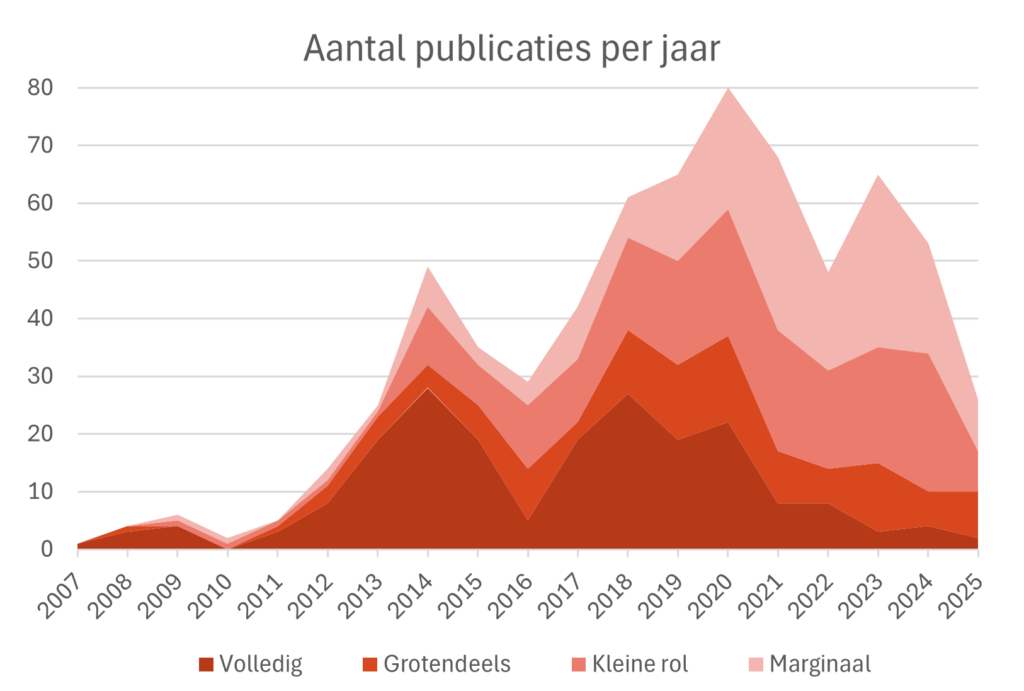
Deze grafiek toont het aantal artikelen per jaar uitgesplitst naar de mate waarin het artikel over Zwarte Piet gaat. Van volledig tot marginaal. Goed zichtbaar is dat de publicaties van deze artikelen samenhangen met anti-Zwarte Piet acties. Het feit dat Zwarte Piet in de publicaties een steeds kleinere rol speelt, komt doordat het vermeende racisme of verband met trans-Atlantische slavernij hier niet meer uitgelegd of onderbouwd wordt. Het wordt als waarheid gezien en gebruikt om andere beweringen te bevestigen.
1 Cathelein Aaftink
Scriptie: Innocence in Baldwin and Wekker compared, Different times, Same innocence (2019)
2 Noes Aaltink
Scriptie: Online postkolonialisme, koloniale (re)presentatie op de website van het Rijksmuseum (2021)
3 Linda Aarts
Scriptie: Het grote Zwarte Piet debat, een discoursanalyse vanuit zorgethisch perspectief (2016)
4 Tendayi Achiume, Professor
Rapport: Visit to the Netherlands, Report of the Special Rapporteur (2020)
5 Ilke Adam, Professor
Artikel: Understanding the Controversy of ‘Black Pete’ through the Lens of Symbolic Representation (2019)
6 Jennifer Adams
Artikel: Culturally relevant/responsive and sustaining pedagogies in science education: theoretical perspectives and curriculum implications (2022)
7 Sarah J. Adams
Artikel: Blackface Burlesque, Changing Praxes and Poetics of Blackness in the Dutch Repertoire before Minstrelsy, 1790-1830 (2019)
Boek: Repertoires of slavery : Dutch theater between abolitionism and colonial subjection, 1770-1810 (2023)
Artikel: The Legitimacy of Resistance in Dutch Abolitionist Theater (2023)
8 Dariya Afanasyeva
Scriptie: The Case of Black Pete “Netherlands most popular tradition under fire” (2017)
9 Sallie Afram
Scriptie: Zwarte Piet, Cultural heritage or a violation of the prohibition of discrimination? (2020)
10 Maria Pau Aguiló Vilella
Scriptie: La tradició literària des de la reinterpretació: la poesia de Dolors Miquel com a contraescriptura (2022)
11 Abderrahman El Aissati
Scriptie: Black as Soot (2014)
12 Soumia Akachar
Artikel: Understanding the Controversy of ‘Black Pete’ through the Lens of Symbolic Representation (2019)
13 Basak Akkan
Artikel: Education and justice: inclusion, exclusion and belonging (2020)
14 Paul van den Akker, Professor
Dissertatie: Appeltjes van Oranje. Sinterklaas en natievorming in de negentiende eeuw (2025)
15 Indra Albrecht
Scriptie: How we look at Congo (2021)
16 Ayse Aldemir
Artikel: Racism and discrimination during the COVID-19 pandemic: Experiences of Turkish migrant women in the Netherlands (2024)
17 Floris van Alebeek
Scriptie: ‘Betwist erfgoed’ Een praktische opdracht over erfgoed, conflict, en identiteit(en). (2019)
18 Mark Alfano
Artikel: Van mening veranderen op Twitter? Zwarte Piet als casus (2020)
19 Rose Mary Allen
Essay: Laten wij kinderen niet als excuus gebruiken in het Zwarte Pieten-debat (2015)
Artikel: De roep op Curaçao om genoegdoening, herstel en compensatie (2023)
Tijdschrift: Slavernijverleden en racisme (2023)
Artikel: Slavery and Debates about National Identity and Nation-Branding (2023)
Boek: Staat en slavernij. Het Nederlandse koloniale slavernij en haar doorwerkingen (2023)
20 Luc Alofs
Artikel: Caraibisch erfgoed en onderwijs, Naar een didactiek voor immaterieel erfgoededucatie in de Nederlandse Cariben (2021)
Boek: Caribbean Cultural Heritage and the Nation (2023)
21 Julia Alting
Artikel: An intercultural ‘Amsteldam’ Dish (2021)
22 Rozemarije Ameling
Scriptie: Far from right, An analysis on the normalization of far-right exclusivism by political parties in the Netherlands (2022)
23 Emma-Lee Amponsah
Artikel: Towards a Black Cultural Memory, Black Consciousness and Connectivity in the Online-Offline Continuum (2023)
24 Agnes Andeweg
Artikel: Layering the Cultural Archive: A Critical Reading of Gloria Wekker’s White Innocence and Rembrandt’s Painting of Two Black Men (2022)
25 Iris Andriessen
Rapport: Integratie in zicht? (2016)
26 Lana Andringa
Artikel: “My Color Doesn’t Lie”: Race, Gender, and Nativism among Nurses in the Netherlands (2020)
27 Dominique Ankoné
Essay: Migration and Colonialism: Call for Equal and Reciprocal Deliberation (2017)
28 An Ansoms, Professor
Scriptie: Les patrimoines locaux face à la migration : Analyse des polémiques autour du Père Fouettard en Belgique et aux Pays-Bas (2019)
29 Miriyam Aouragh, Professor
Artikel: ‘White privilege’ and shortcuts to anti-racism (2019)
30 Ana Lucia Araujo, Professor
Artikel: Afterword: Ghosts of Slavery (2020)
31 Marta Araújo
Artikel: Mobilizing History: Racism, Enslavement and Public Debate in Contemporary Europe (2022)
32 Siela Ardjosemito-Jethoe
Opinie: Een constructief gesprek over een inclusief Sinterklaasfeest (2020)
33 William Arfman
Video: Docent Tilburg School of Catholic Theology William Arfman over Zwarte Piet en Identity Markers (2020)
34 Csilla Ariese
Artikel: Amplifying Voices: Engaging and Disengaging with Colonial Pasts in Amsterdam (2021)
Artikel: Visiting the Amsterdam Museum: Studying Visitors’ Responses to Decolonial Practices (2021)
35 Enrique Armijo, Professor
Artikel: Online Must-Carry in Comparative Perspective (2024)
36 Soraya Arou-Gouya
Scriptie: In Search of Constructive Race Talks (2021)
37 Sarah Asmelash
Essay: Mass Media: The Construction of Ethnic Stereotypes (2014)
38 Jasper van Assche
Scriptie: Zwarte Piet, wiedewiedewiet, ben ik een racist of niet? (2021)
39 Lucas Asselbergs
Opinie: Behoefte aan statement tegen racisme (2020)
40 Lucy Avraamidou, Professor
Artikel: Culturally relevant/responsive and sustaining pedagogies in science education: theoretical perspectives and curriculum implications (2022)
41 Isabel Awad
Opinie: Reconsider decision about zwarte piet (2014)
Opinie: Universiteit ontwijkt het Zwarte Piet-debat (2014)
Magazine: Piet, handboek voor een moderne sinterklaasviering (2015)
42 Frank Baaijens
Opinie: Behoefte aan statement tegen racisme (2020)
43 Catherine Baker
Artikel: Your race sounds familiar? (2021)
44 Megan Baker
Scriptie: Fostering a Critical Consciousness for Social and Political Change: A Case Study of Youth-led Organizing in The Netherlands (2015)
45 Edwin Bakker, Professor
Artikel: Rallying around empty signifiers: understanding and defining anti-government protest in the Netherlands (2023)
46 Justine Bakker
Scriptie: Eenheid in diversiteit? Interculturele contacten tussen christenen in Nederland (2023)
47 Joep Bakker
Opinie: Een streep door discriminatie? (2015)
48 Amisah Zenabu Bakuri
Artikel: Black and White in Church? The legacy of slavery and colonialism (2023)
Tijdschrift: Slavernijverleden en racisme (2023)
49 Mieke Bal, Professor
Boek: Zwarte Piet’s Bal Masqué (1999)
50 Sruti Bala
Workshop: Humorous Approaches to Art and Activism in Conflict (2013)
51 Markus Balkenhol
Opinie: Policing tradition (2011)
Essay: Racism as Satire (2013)
Dissertatie: Tracing slavery, An ethnography of diaspora, affect, and cultural heritage in Amsterdam (2014)
Lezing: Zwarte Piet, a history (2014)
Artikel: Zwarte Piet, Racisme, Emoties (2015)
Artikel: The nativist triangle. Sexuality, race, and religion in discourses on ‘Dutchness’ (2016)
Essay: Ras en racisme in kunst en cultuur 2017 (2017)
Interview: Zwarte Piet anno 2018, aflevering 1 (2018)
Artikel: Odd Bedfellows, New Alliances (2019)
Interview: Pietendiscussie gaat over de vraag wat onze identiteit is (2019)
Interview: Zorgen om Zwartepietdiscussie (2019)
Artikel: Zwarte Pieten, moskeebezoek en zoenende mannen (2019)
Essay: Humanisme en paternalisme in de Amsterdamse slavernijdiscussie (2020)
Boek: The Secular Sacred: Emotions of Belonging and the Perils of Nation and Religion (2020)
Interview: Slavernij en de relatie met het Amsterdam van nu (2021)
Discussie: Travelling concepts, Episode 6: Heritage (2021)
52 Nils Bandelow, Professor
Rapport: Sustainable Governance Indicators 2017, Netherlands Report (2017)
53 Hanneke Bartelds
Artikel: Students’ and teachers’ beliefs about historical empathy in secondary history education (2020)
54 Darryl Barthe
Opinie: Decolonizing Zwarte Piet (2018)
55 Joshua Bernard Baum
Scriptie: European “Blackfishing”: Perspectives on the Legitimacy (or Not) of Cosmetic Racial Identities (2019)
56 Sofie van Bauwel
Essay: een volle zak op de schouders (2018)
57 Jean Beaman, Professor
Artikel: Towards a Reading of Black Lives Matter in Europe (2021)
58 Charlie Beckett, Professor
Opinie: Racism or Tradition? the Dutch ‘Golliwog’ Row (Sinterklaas) (2009)
59 Wouter van Beek, Professor
Lezing: Zwarte Piet in Afrika: rite en ruzie (2015)
60 Pascal van den Beemd
Scriptie: Black as Soot (2014)
61 Jorieke Beernink
Scriptie: Imagining integration (2022)
62 Marloes Beers
Scriptie: Bruggen slaan, Een onderzoek naar de ontwikkeling van maatschappelijk- en politiek antiracisme in de jaren 80 en de jaren 10 (2019)
63 Elisabeth Bekers, Professor
Artikel: Reading White Innocence across Disciplines in the Low Countries (2022)
64 Lucky Belder
Artikel: Living cultural heritage in the Netherlands: the debate on the Dutch tradition of Sinterklaas (2018)
65 Vasiliki Belia
Scriptie: Dutch tolerance, innocence and color-blindness (2020)
66 Ine Beljaars
Dissertatie: Embodies encounters: Afro-Latin dance and Dutch cultural identity (2023)
67 Yvonne Benschop, Professor
Dissertatie: Doing diversity work: Unravelling the interplay between change and resistance in the Dutch Militairy (2025)
Artikel: Spinning in circles. Following the practices of non-performativity of a diversity committee (2025)
68 Bianca Berends
Scriptie: Zwarte Piet en Witte Klaas (2000)
69 Martin Berger
Scriptie: Slavery on Display (2018)
Artikel: ‘All the things happening outside of the museum push me back in’: thinking through memory and belonging in
Amsterdam’s Tropenmuseum (2021)
Scriptie: What? A museum is evolving!: The changing mission of the ethnographic European museum (2023)
70 Maurits Berger, Professor
Boek: Halalborrel (2020)
71 Anne van den Bergh
Essay: Rendering Legible the Black Page in Dutch History: a Reading of Zwarte Piet (2016)
72 Michaël Berghman
Artikel: ‘Wear Clogs and just Act Normal’: Defining Collectivity in Dutch Domestic Music Concerts (2020)
73 Saskia van Berkel
Scriptie: Representation, reflection and reconstruction of identity: The intersection of black British history and British television, 1960-2015 (2017)
74 Anne Berkheij
Scriptie: Power Relations and Recognition (2016)
75 Emmeline Besamusca
Scriptie: Zwarte Piet in het Nieuws (2017)
Scriptie: Excuseren of zwijgen? (2023)
76 Christiaan de Beukelaer
Essay: Why the Netherlands is more split on ‘Black Pete’ than ever (2018)
Artikel: Ordinary culture in a world of strangers: toward cosmopolitan cultural policy (2019)
77 Berber Bevernage
Scriptie: Slavernij is voorbij! Laat de Zwarte Pieten vrij! (2017)
78 Dirk Bezemer, Professor
Boek: Een land van kleine buffers (2020)
79 Kees Biekart
Scriptie: Holding up the Mirror, Anti-Racism Narratives Resisting Dutch Tales of Tolerance (2021)
80 Bert Bieleman
Scriptie: Is de politie een afspiegeling van de samenleving? (2023)
81 Hester Bijl, Professor
Opinie: Een constructief gesprek over een inclusief Sinterklaasfeest (2020)
82 Greetje Bijl
Interview: Genderview Roline Redmond (2023)
Interview: Vaderlandse geschiedenis creëert witte onschuld (2023)
83 Aspha Bijnaar
Essay: Opgepakt bij de intocht. Wat heeft Zwarte Piet met het Sinterklaasfeest te maken? (2014)
Artikel: Zwart als roet Zwarte Piet in de liberale rechtsstaat (2014)
Artikel: Minima Philosophica:De zaak van Sinterklaas (2) (2015)
Scriptie: Slavery on Display (2018)
84 Emma van Bijnen
Boek: The Future of the Dutch Colonial Past (2024)
85 Werner Binder
Scriptie: European “Blackfishing”: Perspectives on the Legitimacy (or Not) of Cosmetic Racial Identities (2019)
86 Claire Bishop, Professor
Dissertatie: Ludic Conceptualism: Art and Play in the Netherlands, 1959to 1975 (2017)
87 Allison Blakely, Professor
Artikel: Santa’s Black Aide A Glimpse of Race Relations in Holland (1980)
Boekbespreking: Smash the Pillars: Decoloniality and the Imaginary of Color in the Dutch Kingdom (2019)
Essay: Attacking Zwarte Piet (2020)
88 George Blaustein
Scriptie: Race: Between Slavery and Emancipation (2013)
89 Maaike Bleeker, Professor
Dissertatie: Comedians without a Cause (2023)
90 Sophia Blijden
Scriptie: De (neo)koloniale paradox (2018)
91 Gemma Blok, Professor
Essay: Coen hoort bij Hoorn’. Emoties rond een omstreden standbeeld (2020)
Dissertatie: Appeltjes van Oranje. Sinterklaas en natievorming in de negentiende eeuw (2025)
92 Marijke Boer
Scriptie: Je bent dom en racistisch (2022)
93 Laura Boerhout
Opinie: 2013 wordt het laatste jaar dat we over Zwarte Piet praten (2012)
Essay: Zwarte Piet, a Bitter Treat? Racial Issues in The Netherlands and the U.S. (2012)
94 Linda Boersma, Professor
Scriptie: Lubaina Himid, Cultureel activist in heden en verleden (2020)
95 Thomas Boeschoten
Artikel: Mediating the Black Pete discussion on Facebook: Slacktivism, flaming wars and deliberation (2014)
96 Michael Boiger, Professor
Artikel: When White people experience the weight of the past (2024)
97 Jan de Boom
Rapport: Discriminatie in Context. Een onderzoek naar achtergronden, oorzaken en triggerfactoren van discriminatie van Nederlanders van Afrikaanse herkomst door jongeren in Nederland (2021)
98 Renetta Bos
Scriptie: Let op je woorden: een moreel-normatief kader voor uitspraken van politici (2021)
99 Antal van den Bosch, Professor
Artikel: Calculating Argument Diversity in Online Threads (2021)
100 Anke Bosma
Artikel: Imagining Dutch Slavery Legacies Through the Rural-Urban Divide in the TV Show Grenslanders (2025)
101 Marit Bosman
Scriptie: Facing Black Pete (2020)
102 Sara van den Bossche
Scriptie: Meer dan 150 jaren Zwarte Piet, Een onderzoek naar de representatie van Zwarte Piet in Nederlandstalige boeken van vroeger en nu (2020)
Boek: Authors of Color Reclaiming Black Bodies in Dutch Children’s Literature (2023)
103 Doeko Bosscher, Professor
Opinie: The battle for equality, Academic discrimination (2016)
104 Michiel Bot
Artikel: Demonstratievrijheid en democratie (2017)
Artikel: Is institutioneel racisme echt racistisch? (2022)
105 Petra Boudewijn
Scriptie: Welke ‘waarheid’ wil jij (niet) zien? (2024)
106 Carla van Boxtel, Professor
Dissertatie: Sensitive history under negotiation (2014)
Artikel: Heritage as a resource for enhancing and assessing historical thinking (2015)
Artikel: Students’ and teachers’ beliefs about historical empathy in secondary history education (2020)
107 Sofie de Brabandere
Scriptie: P(r)ietpraat? Het zwartepietendebat in de Vlaamse jeugdbeweging (2021)
108 Sarah Bracke, Professor
Essay: Daar wordt aan de deur geklopt… Over levende tradities, broodnodige dekolonisering en de uittocht van Zwarte Piet (2015)
Artikel: Dancing in the Rain: Intersectionality in Motion (2025)
109 Pepijn Brandon, Professor
Boek: De slavernij in Oost en West: Het Amsterdam onderzoek (2020)
Boek: The Future of the Dutch Colonial Past (2024)
110 Nella van den Brandt
Opinie: Zwarte Piet: alleen een kwestie van racisme, of ook seksisme? (2012)
111 Jan Bransen, Professor
Dissertatie: The Circumstances of Self-Knowledge (2024)
112 Alex Brenninkmeijer, Professor
Essay: Het recht om te escaleren. Het Pietendebat in de rechtszaal (2014)
113 Rebecca Brienen, Professor
Essay: Types and stereotypes, Zwarte Piet and his early modern sources in Dutch Racism (2014)
114 Anna Brigevich
Scriptie: The Populist Radical Right on Their Colonial Past (2023)
115 Boukje Brink-Klinker
Scriptie: Wiede wiede wiet, ik hoor je wel maar ik zie je niet (2021)
116 Lida van den Broek
Boek: Wit is nu aan zet (2020)
117 Anke van den Broek
Scriptie: “Want al ben ik zwart als roet, ‘k meen het wel goed” (2021)
118 Jora Broerse
Artikel: Community music, identity and belonging among Dutchies in Australia (2024)
119 Larike Henriette Bronkhorst
Artikel: Situationality in discussing controversial topics: (2024)
Scriptie: Decolonising a Dutch literature course: from Dutch literature to literature in Dutch (2025)
120 Anke Brons
Scriptie: Addressing whiteness and racism in the Alternative Food movement (2023)
121 Leendert Brouwer
Artikel: Family Name Adoption in the Dutch Colonies at the Abolition of Slavery in the Context of National Family Name Legislation (2023)
122 Rowan Brouwers
Artikel: De steun voor dekolonisering in België in kaart gebracht: tussen politieke gevoeligheden en maatschappelijke aanvaarding (2022)
123 Myrthe Brouwers
Scriptie: Decolonising a Dutch literature course: from Dutch literature to literature in Dutch (2025)
124 Anna-Kay Brown
Artikel: Trapped by Narcissism: A Disillusioned Dutch Society (2012)
125 Pieter de Bruijn
Artikel: Teaching sensitive topics: Training history teachers in collaboration with the museum (2024)
126 Ymke de Bruijn
Artikel: Crisis and bias:Exploring ethnic prejudice among Chinese-Dutch children (2023)
127 boudewijn de Bruin, Professor
Opinie: The battle for equality, Academic discrimination (2016)
128 Rodrigo Bueno Lacy
Scriptie: Far from right, An analysis on the normalization of far-right exclusivism by political parties in the Netherlands (2022)
129 Elizabeth Buettner, Professor
Boek: Europe after Empire: Decolonization, Society, and Culture (2016)
130 Ayse Bugra, Professor
Artikel: Education and justice: inclusion, exclusion and belonging (2020)
131 Jacoline Buirma
Scriptie: Dealing with the colonial past: public perceptions of slavery in museums. (2019)
132 Peter Burger
Scriptie: Want al ben ik zwart als roet, ‘k meen het toch goed (2014)
133 Mason D. Burns
Artikel: Support for Native-Themed Mascots and Opposition to Political Correctness (2022)
134 Christina Buta
Artikel: Anti-fascism (2019)
135 Jelle van Buuren
Artikel: Rallying around empty signifiers: understanding and defining anti-government protest in the Netherlands (2023)
136 Nicchelle Buyne
Scriptie: Embodied Resistance, An Interdisciplinary Analysis of Contemporary Protest against black Pete (2022)
137 Enzo Cáceres Quezada
Artikel: When White people experience the weight of the past (2024)
138 Artwell Cain
Artikel: Slavery and Memory in the Netherlands: Who Needs Commemoration? (2016)
Rapport: Uitsluitingsmechanismes van mensen van Afrikaanse afkomst in Nederland: Wat is erover bekend (2017)
Essay: Decoloniality of Memory and Anti-Black Racism (2018)
Boek: The Cultural Heritage Dilemma of Afro-Dutch Youth (2023)
139 Kadir Canatan, Professor
Rapport: Mensenrechten Rapport Nederland 2014, Minderheden tussen islamofobie en integratie (2014)
140 Laura Candidatu
Scriptie: The Shifting Definition of Racism, White Dutch Citizens’ Perceptions and Emotions in the Face of the Political Discursive Shift on Institutional Racism (2023)
141 Sinan Çankaya
Opinie: De meerderheid van Nederland is tegen aanpassing van Zwarte Piet. Ik vond 4 verklaringen (2016)
Scriptie: Van zwart naar wit (2017)
Artikel: Facing racism: discomfort, innocence and the liberal peripheralisation of race in the Netherlands (2019)
Scriptie: “De Zwarte Pieten-discussie hoort niet in de politiek.” (2020)
142 Lucio de Capitani
Artikel: Postcolonial social dramas in European provincial towns: Frank Westerman’s literary journalism (2021)
143 Esther Captain, Professor
Boek: Staat en slavernij. Het Nederlandse koloniale slavernij en haar doorwerkingen (2023)
144 Vittoria Caradonna
Artikel: ‘All the things happening outside of the museum push me back in’: thinking through memory and belonging in Amsterdam’s Tropenmuseum (2021)
Dissertatie: Memory as resource and property (2023)
Artikel: ‘These are large ideals that we hope for’: heritagising the past and present of anti-racist activism in the Black Archives
(2024)
145 Marcos Cardão
Artikel: O blackface em Portugal. Breve história do humor racista (2020)
146 Antonio Carmona Báez
Boek: Smash the Pillars: Decoloniality and the Imaginary of Color in the Dutch Kingdom (2018)
147 Quassim Cassam, Professor
Dissertatie: The Circumstances of Self-Knowledge (2024)
148 Amy Casteel
Artikel: Child Theology, Spirituality and Intersectionality (2024)
149 Amandine Catala
Artikel: Multicultural Literacy, Epistemic Injustice, and White Ignorance (2019)
150 Jana Cattien
Scriptie: In Search of Constructive Race Talks (2021)
151 Karen Celis, Professor
Artikel: Understanding the Controversy of ‘Black Pete’ through the Lens of Symbolic Representation (2019)
152 Bambi Ceuppens
Interview: Ik denk niet dat we noodzaak hebben aan een ‘officiële waarheid’ (2016)
Boek: Pietpraat, over Zwarte Piet in België (2019)
153 Sharon Chamman
Scriptie: The Importance of Intersectionality: Experiences of Women of Color of Ethnic Profiling in the Netherlands (2020)
154 David Chan
Scriptie: Racial and Ethnic Perceptions of Middle Eastern and North African People in Belgium (2024)
155 Sébastien Chauvin
Scriptie: Inside the chimney. An exploration of racial dynamics in the struggle over a Dutch tradition (2015)
Artikel: Race and the Pitfalls of Emotional Democracy: Primary Schools and the Critique of Black Pete in the Netherlands
(2017)
Artikel: Never Having Been Racist: Explaining the Blackness of Blackface in the Netherlands (2018)
Interview: Zwarte Piet anno 2018, aflevering 4 (2018)
156 Innocent Chiluwa, Professor
Artikel: Investigating the language of conflict and peace in critical discourse studies (2024)
157 Sven Chojnacki, Professor
Scriptie: The Staging of Innocence: Orientalism, Theatrical Representation & The Dutch Tradition of Black Pete (2018)
158 Amber de Clerck
Artikel: Unpacking Cultural Logics: A Rhetorical Listening Analysis of the Public Black Pete Debate in Flanders (2022)
Rapport: Rhetorical Listening as a Pedagogical Tool in Higher Education: Exploring the Black Pete Debate in Flanders (2024)
Artikel: Queen Nikkolah’s reign: revealing racial denial in Flanders through a rhetorical listening analysis of the Queen Nikkolah
debate (2025)
159 Yannick Coenders
Scriptie: Inside the chimney. An exploration of racial dynamics in the struggle over a Dutch tradition (2015)
Boekbespreking: Historiseren, relaties leggen en taboes doorbreken (2016)
Opinie: Lekker stereotyperen; De nieuwe Zwarte Pieten (2016)
Artikel: Race and the Pitfalls of Emotional Democracy: Primary Schools and the Critique of Black Pete in the Netherlands
(2017)
Artikel: Never Having Been Racist: Explaining the Blackness of Blackface in the Netherlands (2018)
Interview: Zwarte Piet anno 2018, aflevering 4 (2018)
160 Marci Cottingham
Artikel: “My Color Doesn’t Lie”: Race, Gender, and Nativism among Nurses in the Netherlands (2020)
161 Guusje Coumans
Scriptie: ‘You can’t blame me for all the misery in the world’: Perceived Moral Judgment Within Right and Far-Right Reddit Spaces (2022)
162 Camille Creyghton
Scriptie: Oriëntalisme: van een academisch discours tot kolonialisme (2021)
163 Maurice Crul, Professor
Interview: The Fight Over ‘Black Pete’ Brings a Reckoning on Racial Equality in the Netherlands (2019)
164 Swelia da Silva Antonio
Scriptie: Racism in the Dutch football scene: The public outcry (2022)
165 Jessica d’Abreu
Artikel: The Black Archives: Exploring the Politics of Black Dutch Radicals (2019)
Artikel: Let Us Not Erase Black Activism When Remembering the Dutch Colonial Past (2024)
166 Serena D’Agostino
Artikel: Understanding the Controversy of ‘Black Pete’ through the Lens of Symbolic Representation (2019)
167 Koen Damhuis
Artikel: Situationality in discussing controversial topics: (2024)
168 Chantal d’Amore
Artikel: Attitude Moralization Within Polarized Contexts: An Emotional Value-Protective Response to Dyadic Harm Cues (2022)
169 Daan van Dartel
Artikel: Susan Stockwell’s Territory Dress: Contemporary art and fashion in a Dutch ethnographic museum (2020)
170 Sudeep Dasgupta
Scriptie: Zwarte Piet, wie kent hem niet… Een onderzoek naar de ontwikkeling in de beeldvorming van Zwarte Piet in Nederlandse televisieseries. (2009)
Boekbespreking: Uncomfortable Ethnographies:The Politics of Race and the Untimeliness of Critique (2017)
171 Sharily Deen
Artikel: Tracing pasts and colonial numbness: decolonial dynamics in the Netherlands (2018)
172 Karien Dekker
Artikel: Community music, identity and belonging among Dutchies in Australia (2024)
173 Lisenne Delgado
Artikel: Eliminating racism, decolonizing education and building an inclusive society: The role of universities in the Kingdom of the Netherlands (2017)
174 Christine Delhaye
Boek: What About Words? Activism and Cultural Change in the Amsterdam Museum (2024)
175 Victoria Déom
Scriptie: Les patrimoines locaux face à la migration : Analyse des polémiques autour du Père Fouettard en Belgique et aux Pays-Bas (2019)
176 Maaike Derksen
Rapport: De stad vertelt, Vooronderzoek slavernijverleden Eindhoven (2024)
177 Jeroen Dewulf, Professor
Dissertatie: ‘Een knecht der knechten sy hy syne broederen’ Christelijk geloof en slavernij in het Nederlandse Atlantische koloniale rijk van de zeventiende en de achttiende eeuw (2024)
178 Alexander Dhoest
Artikel: Them! Ingroup-outgroup dynamics in Flemish anti-woke discourses on X (2025)
179 Sigurd d’Hondt
Artikel: Confronting blackface, Stancetaking in the Dutch Black Pete debate (2019)
180 Hester Dibbits, Professor
Artikel: De strijd om Zwarte Piet (2005)
Lezing: Delen van het verleden Erfgoed en educatie in de 21ste eeuw (2015)
Lezing: Sharing the Past (2015)
Artikel: Moved by the tears of others: emotion networking in the heritage sphere (2017)
Scriptie: To find your own voice (2017)
Scriptie: Erfgoed in boek en beeld (2022)
181 José van Dijck, Professor
Dissertatie: The Datafication of Race-Ethnicity (2022)
182 Teun van Dijk, Professor
Essay: Sinterklaas en Zwarte Piet: Is het racisme, of is het ’t niet? (1998)
183 Mathilde van Dijk
Artikel: Religion, Gender, and Heritage (2023)
184 Bas Dikmans
Artikel: Everyday Racism’, ‘White Innocence,’ and Postcolonial Society: A Deeper Look into the Dutch Cultural Archive (2020)
185 Annemie Dillen
Artikel: Child Theology, Spirituality and Intersectionality (2024)
186 Tessa Diphoorn
Discussie: Travelling concepts, Episode 6: Heritage (2021)
187 Dagmar Dirkx
Scriptie: Belgisch Congo ontmaskerd (2015)
188 Marieke van den Doel
Scriptie: Monostatos (2023)
189 Egbert Dommering, Professor
Opinie: De Intocht van Boniklasius in Dokkum, dertien eeuwen later (2017)
190 Roelien Donker
Scriptie: Changing the Debate: How Members of Kick Out Zwarte Piet succeed in challenging the Regime of Truth on Black Pete in the Netherlands (2020)
191 Neelke Doorn, Professor
Opinie: Van Zwarte Piet naar atletiek (2015)
192 Bertjan Doosje
Artikel: When White people experience the weight of the past (2024)
193 Nina van Douwen
Dissertatie: Doing diversity work: Unravelling the interplay between change and resistance in the Dutch Militairy (2025)
Artikel: Spinning in circles. Following the practices of non-performativity of a diversity committee (2025)
194 Caroline Drieënhuizen
College: Hoe leidt ons koloniaal verleden tot hedendaags verzet (2019)
Essay: Coen hoort bij Hoorn’. Emoties rond een omstreden standbeeld (2020)
195 Kimberly Ducey
Artikel: Systemic Racism (2017)
196 Linda van Duin
Scriptie: Exploring the Impact of Right-Wing Anti-Gender Politics on Sexual Education Policies in Dutch Elementary Schools (2024)
197 Martijn Duineveld
Scriptie: The other past,a cross-cultural exploration of various conceptualizations of heritage (2017)
198 Zwaan Duinker
Scriptie: Dutch tolerance, innocence and color-blindness (2020)
199 Delia Dumitrica
Scriptie: Corporate ‘action that matters’: How Black Lives Matter activists perceive the role of corporations in the movement’s fight against racism in the Netherlands (2021)
Scriptie: To live in a world with(out) racism (2022)
Artikel: Living in a world with(out) racism: everydayreflexivity among older White Dutch (2024)
200 Catarina Dutilh Novaes, Professor
Opinie: In what sense(s) is the Black Pete tradition racist, if any? (2013)
Opinie: November kan en moet beter (2014)
Essay: Zwarte Piet en de betekenis(sen) van racisme (2014)
Opinie: Bravo Haagse basisscholen! Piet moet anders (2015)
Opinie: The battle for equality, Academic discrimination (2016)
Artikel: Van mening veranderen op Twitter? Zwarte Piet als casus (2020)
Artikel: Can Arguments Change Minds? (2023)
Artikel: Who Gets to Play? (2025)
201 Joachim Duyndam, Professor
Scriptie: Volgens mij, Hoe kunnen we goed volgerschap begrijpen in sociaal-politiek activisme? (2021)
202 Jan Willem Duyvendak, Professor
Opinie: Nederland racistisch? Dá-hag, dá-hag, Zwarte Piet (2013)
Essay: Are All Dutch Racists? A Country’s Struggle with a Black-Face Tradition (2014)
Dissertatie: Out of character: debating Dutchness, narrating citizenship (2014)
Opinie: De radicalisering van het Sinterklaasgeloof (2015)
Boek: The Culturalization of Citizenship (2016)
Artikel: The nativist triangle. Sexuality, race, and religion in discourses on ‘Dutchness’ (2016)
Boek: Thuis: het drama van een sentimentele samenleving (2017)
Artikel: The nation under threat: secularist, racial and populist nativism in the Netherland (2019)
Dissertatie: Building Belonging (2020)
Essay: De nativistische kramp (2021)
Boek: De macht der gewoonte (2022)
Boek: The Return of the Native: Can Liberalism Safeguard Us Against Nativism (2022)
203 Martijn Eickhoff, Professor
Essay: Postkoloniale beeldenstormen? Een repliek op de Daendelslezing 2018 van Gert Oostindie (2018)
204 Koen van Eijck, Professor
Dissertatie: Elvis has Finally Left the building? Boundary work, whiteness and the reception of rock music in comparative perspective (2019)
Artikel: ‘Wear Clogs and just Act Normal’: Defining Collectivity in Dutch Domestic Music Concerts (2020)
205 Naomi Ellemers, Professor
Opinie: Black Pete and the Academic (2014)
206 Martin vander Elst
Essay: Penser et agir politiquement la fin du blackface en Belgique (2019)
Essay: Pour une Ducasse sans blackface: vaincre la négrophobie (2019)
Essay: La contestation du folklore colonial comme droit à la démocratie culturelle (2020)
207 Fatima El-Tayeb, Professor
Artikel: A vida queer da diáspora: negritude Europa colorblind (2020)
208 Sharelly Emanuelson
Essay: The New Black Peter is the Refugee washing up on the shores of Fortress Europe (2015)
209 Akwugo Emejulu, Professor
Artikel: Refusing politics as usual: mapping women of colour’s radical praxis in London and Amsterdam (2022)
210 Rosanneke Emmen
Artikel: National Identification, Social Dominance Orientation, and Attitudes Towards Black Pete in the Netherlands (2022)
Artikel: Crisis and bias:Exploring ethnic prejudice among Chinese-Dutch children (2023)
211 Jiska Engelbert
Opinie: Reconsider decision about zwarte piet (2014)
Opinie: Universiteit ontwijkt het Zwarte Piet-debat (2014)
Magazine: Piet, handboek voor een moderne sinterklaasviering (2015)
212 Gerlov van Engelenhoven
Artikel: A Controversial, But Welcome New Perspective on Structural Racism in Dutch Society (2018)
213 Remco Ensel
Scriptie: Bijval of uitval: Het slavernijverleden en het geschiedenisonderwijs (2021)
Artikel: Holocaust Commemorations in Postcolonial Dutch Society (2021)
214 Timo Epping
Artikel: Teaching sensitive topics: Training history teachers in collaboration with the museum (2024)
215 Karin van Es
Artikel: Mediating the Black Pete discussion on Facebook: Slacktivism, flaming wars and deliberation (2014)
216 Farid Esack, Professor
Lezing: De zwarte piet van de Koran (2017)
217 Mitchell Esajas
Essay: Beyond Blackface: Emancipation Through the Struggle Against Black Pete, Dutch Racism and Afrophobia (2014)
Opinie: Vóór Zwarte Piet? Zo kennen we de eens zo progressieve Dokkumers niet (2017)
Artikel: The Black Archives: Exploring the Politics of Black Dutch Radicals (2019)
Artikel: Let Us Not Erase Black Activism When Remembering the Dutch Colonial Past (2024)
218 Philomena Essed, Professor
Essay: A Brief ABC on Black Europe (2014)
Essay: Afterword: A Second Wave of Dutch Resistance Against Racism (2014)
Boek: Dutch Racism (2014)
Artikel: De terugkeer van Alledaags Racisme (2017)
Interview: Two steps forward, one step back (2017)
Artikel: Humiliation, dehumanization and the quest for dignity (2019)
Rapport: Ketenen van het verleden, Rapport van bevindingen (2021)
219 Evelien Evenhuis
Scriptie: Racial stereotyping in the Netherlands: examining the role of public authorities in the societal debate on the character of Zwarte Piet (2020)
220 Aya Ezawa
Opinie: Een constructief gesprek over een inclusief Sinterklaasfeest (2020)
221 Karwan Fatah-Black
Opinie: Wij hoeven die Piet niet (2012)
Interview: Karwan Fatah-Black: ‘Slavernij is een soort ijkpunt geworden’ (2019)
Interview: Zwarte Piet: geschiedenis en debat – een leeslijst (2020)
Boek: The Future of the Dutch Colonial Past (2024)
Boek: Slavery in the Cultural Imagination (2025)
222 Joe Feagin, Professor
Artikel: Systemic Racism (2017)
223 Aydan Figaroa
Artikel: Living cultural heritage in the Netherlands: the debate on the Dutch tradition of Sinterklaas (2018)
224 Nana Fordjour
Scriptie: Bruggen slaan, Een onderzoek naar de ontwikkeling van maatschappelijk- en politiek antiracisme in de jaren 80 en de jaren 10 (2019)
225 Mariana Françozo
Scriptie: Dealing with the colonial past: public perceptions of slavery in museums. (2019)
226 Chandra Frank
Opinie: Public Statement on Zwarte Piet, Institutional Racism in the Netherlands (2013)
Dissertatie: Can the Archive Speak? Mapping Feminist and Queer Genealogies of Colour in The Netherlands (2020)
227 Bonnie E. French
Scriptie: Turning a Colour-Blind Eye, A content analysis of social media comments on the Black Lives Matter movement in the Netherlands (2021)
Scriptie: Racism in the Dutch football scene: The public outcry (2022)
Scriptie: The Story of that White Conservative who became an Antiracist (2022)
Scriptie: Moments at the veil (2023)
228 Isabelle Frens
Artikel: Rallying around empty signifiers: understanding and defining anti-government protest in the Netherlands (2023)
229 Layal Ftouni
Scriptie: Sweeping Colonialism Under the Historical Rug: A Comparative Analysis of Remembrance of the Dead and Keti Koti Commemorations in the Netherlands (2018)
230 Mario Fumerton
Scriptie: The Importance of Intersectionality: Experiences of Women of Color of Ethnic Profiling in the Netherlands (2020)
231 Jan Hein Furnée, Professor
Artikel: Het beeld van Nederland, Hoe merkreclames onze samenleving hebben gevormd (2020)
232 Coen van Galen
Opinie: Structural racism will not be solved by a Sooty-faced Piet (2020)
233 Nicole Ganbold
Scriptie: The Absent Presence. The Image of Black People in the Seventeenth Century Dutch Painting (2021)
234 Soenita Ganpat
Rapport: Doorwerking van het slavernij- en koloniale verleden en wegen naar erkenning: stemmen uit Zuid-Holland (2023)
235 Des Gasper, Professor
Boek: Fear of Flooding: Convivial Racism in The Netherlands (2022)
236 Daniela van Geenen
Artikel: Mediating the Black Pete discussion on Facebook: Slacktivism, flaming wars and deliberation (2014)
237 Lonneke Geerlings
Interview: Ik denk niet dat we noodzaak hebben aan een ‘officiële waarheid’ (2016)
238 Hilde van Gelder, Professor
Scriptie: Belgisch Congo ontmaskerd (2015)
239 Peter Geschiere, Professor
Boek: The Culturalization of Citizenship (2016)
240 Anna Geurts
Opinie: Blackface fout, drag goed? (2019)
241 Machteld Geuskens
Artikel: Folk Paradigms of Justice in Commemoration and Heritage in the Postcolonial Netherlands (2025)
242 Chihiro Geuzebroek
Boek: Provocative intervention (2024)
243 Halleh Ghorashi, Professor
Artikel: Taking racism beyond Dutch innocence (2020)
244 Maarten van Ginderachter, Professor
Scriptie: “Want al ben ik zwart als roet, ‘k meen het wel goed” (2021)
245 Jaap van Ginneken
Interview: Zwarte Piet anno 2018, aflevering 3 (2018)
246 Andreas Giorgiallis
Artikel: The racial regime of international cultural heritage law (2025)
247 Idesbald Goddeeris, Professor
Opinie: Zwarte Piet, en wat de Belg niet ziet (2013)
Artikel: Mapping the Colonial Past in the Public Space (2020)
248 Miguel Goede
Boek: Dissent is Democracy (2024)
249 Sharishma Goeptar
Scriptie: Welke ‘waarheid’ wil jij (niet) zien? (2024)
250 Guido Goijens
Artikel: Teaching sensitive topics: Training history teachers in collaboration with the museum (2024)
251 Linda Maria Goltsche
Scriptie: The Social Impact of Ethnological Museums in a Multicultural Society (2014)
252 Elena Gonzales
Boek: Welcome, inclusion, and sharing authority (2019)
253 Marie Goodman
Scriptie: The Zwarte Piet Debate: A Current Analysis of the Zwarte Piet Debate and the Application of Changes to the Sinterklaas Tradition (2021)
254 Ernestine Gordijn, Professor
Scriptie: Morele Woede en Gender; De Woede Uiten of Onderdrukken? (2025)
255 Magdalena Górska
Scriptie: Facing Black Pete (2020)
256 Jordy Gosselt
Scriptie: Being confronted with opposites (2016)
257 Karina Goulordava
Artikel: Black Pete, “Smug Ignorance,” and the Value of the Black Body in Postcolonial Netherlands (2014)
258 Shannon Gouppy
Artikel: Race Matters in Belgium: A Critical Exploration of the Belgian Post-racial Paradox (2024)
259 Henriët Graafland
Scriptie: Sharing history and heritage with Indonesia and Suriname (2019)
260 Melle Graff
Scriptie: Omgaan met verschillen in het kader van burgerschapsonderwijs (2021)
261 Erica L. Granz
Artikel: Support for Native-Themed Mascots and Opposition to Political Correctness (2022)
262 Maria Grever, Professor
Dissertatie: Sensitive history under negotiation (2014)
Artikel: Heritage as a resource for enhancing and assessing historical thinking (2015)
Presentatie: Boekpresentatie Onontkoombaar verleden (2020)
Artikel: Histories of an Old Empire: The Ever-Changing Acknowledgement of Dutch Imperialism as a Present Past (2023)
Artikel: Conversations about Contested Pasts (2024)
263 Christian Groes
Boek: Postcolonial Europe: Comparative Reflections after the Empires (2018)
264 Selma de Groot
Scriptie: Valt er in het civiele recht nog een juridische pepernoot te kraken betreffende het fenomeen Zwarte Piet? (2018)
265 Judith Gruber, Professor
Artikel: Heilungs- oder Geistergeschichten? Post/koloniale Erinnerung im belgischen AfrikaMuseum (2020)
266 Francio Guadeloupe
Essay: The New Black Peter is the Refugee washing up on the shores of Fortress Europe (2015)
Lezing: De kracht van het starten van een nieuw inclusiever feest (2017)
Scriptie: A community building on hope (2018)
Rapport: Ketenen van het verleden, Rapport van bevindingen (2021)
Boek: Black Man in the Netherlands: An Afro-Antillean Anthropology (2022)
Boek: Caribbean Cultural Heritage and the Nation (2023)
Boek: Caribbean diasporas, metropolitan policies, and cultural heritage (2023)
Artikel: Caribbean Diasporas, Metropolitan Policies, and Cultural Heritage (2023)
267 Laura Gurwin
Scriptie: Audience Engagement on Twitter: The Rijneveld Translation Controversy (2021)
268 Adriano José Habed
Scriptie: Exploring the Impact of Right-Wing Anti-Gender Politics on Sexual Education Policies in Dutch Elementary Schools (2024)
269 Margaret Hagerman
Scriptie: Identity formation of Black Surinamese Dutch women (2021)
270 Maarten Hajer, Professor
Dissertatie: Keeping things gezellig, Negotiating Dutchness and racism in the struggle over ‘Black Pete’ (2019)
271 Jordi Halfman
Essay: The New Black Peter is the Refugee washing up on the shores of Fortress Europe (2015)
Lezing: De kracht van het starten van een nieuw inclusiever feest (2017)
272 Cees Hamelink, Professor
Dissertatie: Sweet breakaway (2020)
273 Fadie Hanna
Artikel: Learning about racism: A week-by-week qualitative exploration (2023)
274 Sarah Hardus
Scriptie: Fostering a Critical Consciousness for Social and Political Change: A Case Study of Youth-led Organizing in The Netherlands (2015)
275 Bryan van Haren
Scriptie: Zie ginds komt het Zwarte Pieten debat uit Spanje weer aan (2019)
276 Joane Hartendorp
Scriptie: Common ground in Dutch Slavery and Holocaust education (2023)
277 Rebecca Hayes, Professor
Artikel: Black Petes & Black Crooks? Racial stereotyping and offending in the Netherlands (2018)
278 Chayla Haynes
Artikel: Black women academics and intersectional erasure in the Netherlands (2024)
279 Coen Heijes
Opinie: Netherland’s Racist Black Pete Tradition Is Apparently Exempt To Worldwide Racial Reckoning (2020)
Artikel: Black Pete: An annual tradition or a national embarrassment? (2025)
280 Waldo Heilbron
Boek: De toekomst van het verleden: Reflecties over Nederlands slavernijverleden (2024)
281 John Helsloot
Artikel: De strijd om Zwarte Piet (2005)
Artikel: De ambivalente boodschap van de eerste ‘Zwarte Piet’ (1850) (2008)
Lezing: Debat Zwarte Piet Yes or No. Van Abbemuseum (2008)
Essay: Is Zwarte Piet uit te leggen? (2009)
Lezing: Naar een afscheid van Zwarte Piet (2012)
Artikel: Zwarte Piet and Cultural Aphasia in the Netherlands (2012)
Artikel: Contesting Ambiguïty: The Black Peter Mask in Dutch Cultural Heritage (2013)
282 Ernst van den Hemel
Artikel: Odd Bedfellows, New Alliances (2019)
Artikel: Zwarte Pieten, moskeebezoek en zoenende mannen (2019)
Essay: Social media and affective publics (2020)
Boek: The Secular Sacred: Emotions of Belonging and the Perils of Nation and Religion (2020)
Artikel: Calculating Argument Diversity in Online Threads (2021)
283 Inge Hendriks
Artikel: Public support for political apologies for slavery (2024)
284 Barbara Henkes
Essay: Postkoloniale beeldenstormen? Een repliek op de Daendelslezing 2018 van Gert Oostindie (2018)
285 Hendrik Henrichs
Scriptie: Toen was toen, nu is nu (2015)
286 Joke Hermes
Artikel: ‘We have given up so much’: Passion and denial in the Dutch Zwarte Piet (Black Pete) controversy (2015)
Artikel: Tracing cultural citizenship online (2020)
Scriptie: Making sense of Crime in the Media (2022)
Boek: Cultural Citizenship and Popular Culture (2023)
287 Gonda van den Heuvel
Artikel: Onder de huid van Zwarte Piet (2018)
288 Jing Hiah
Artikel: Framing justice in struggles over cultural heritage: the case of Black Pete in the ‘postcolonial’ Netherlands (2023)
Artikel: Folk Paradigms of Justice in Commemoration and Heritage in the Postcolonial Netherlands (2025)
289 Helena Hickson
Artikel: When White people experience the weight of the past (2024)
290 Manou Hijlkema
Scriptie: (T)races in the Afrikaanderwijk (2019)
291 Antoinette Hildering, Professor
Scriptie: Back to Black Pete, freedom of expression and non-discrimination under the european court of human rights; a case study on zwarte piet (2018)
292 Sacha Hilhorst
Artikel: ‘We have given up so much’: Passion and denial in the Dutch Zwarte Piet (Black Pete) controversy (2015)
293 Channah Hilhorst
Scriptie: Addressing whiteness and racism in the Alternative Food movement (2023)
294 Helen Hintjens
Scriptie: Decolonising Contemporary Art? Four Global Artists and Collage+ (2014)
Boek: Fear of Flooding: Convivial Racism in The Netherlands (2022)
295 Niek van Hirtum
Scriptie: Overgaan tot de orde van de dag: heersen en niet verdelen, Dominantie van blanke Nederlanders in Nederland (2013)
296 Anne-Lot Hoek
Opinie: Zwarte Piet(3) (2018)
297 Shemona Hofland
Scriptie: “Jouw huidskleur lijkt op poep en dat is vies” (2020)
298 Barend Peter Hofstede
Artikel: Persona non grata, The case of Zwarte Piet (1990)
299 Mirjam Hoijtink
Scriptie: Emotions as Factors of Social and Cultural Change in Museological Discourses (2019)
300 Palau Holst
Scriptie: Us & Them? Experiences with polarization dynamics from the perspective of black migrant communities in the Netherlands (2020)
301 Julia Holzmann
Boek: Geschichte der Sklaverei in der Niederländischen Republik (2021)
302 Frank den Hond
Scriptie: Wiede wiede wiet, ik hoor je wel maar ik zie je niet (2021)
303 Dienke Hondius
Artikel: Blacks in Early Modern Europe: New Research from the Netherlands (2009)
Artikel: Race and the Dutch. On the uneasiness surrounding racial issues in the Netherlands (2009)
Essay: Opgepakt bij de intocht. Wat heeft Zwarte Piet met het Sinterklaasfeest te maken? (2014)
Essay: Doorwerkingen van slavernijverleden (2023)
304 Rick Honings, Professor
Scriptie: De (neo)koloniale paradox (2018)
305 Robert Hoppe, Professor
Rapport: Sustainable Governance Indicators 2017, Netherlands Report (2017)
306 Robert Hornback, Professor
Boek: Racism and Early Blackface Comic Traditions (2018)
307 Jos Hornikx, Professor
Scriptie: De kracht van een tweezijdige boodschap (2023)
308 Teun van Hout
Scriptie: The influence of cultural nationalism on the discourse oftwo Dutch political parties:The PvdA and VVD (2020)
309 Henk van Houtum, Professor
Opinie: Zwart-Wit (2008)
310 Isabel Hoving
Artikel: De strijd om Zwarte Piet (2005)
Boek: Dutch Racism (2014)
Lezing: Van raciale sterotypen naar racisme (2015)
311 Edward Huijbens, Professor
Dissertatie: Making space for hope? (2025)
312 Leonie Huijbers
Scriptie: Zwarte Piet, Cultural heritage or a violation of the prohibition of discrimination? (2020)
313 Marli Huijer, Professor
Scriptie: Zwarte en witte zelfrepresentatie in tijden van sociale media (2018)
314 Willem Huijnk
Rapport: Integratie in zicht? (2016)
315 Jouke Huijzer
Artikel: Animal Politics or Animal Police? Islamophobia and Animal Advocacy Politics (2024)
316 Iris van Huis
Artikel: Contesting Cultural Heritage: Decolonizing the Tropenmuseum as an Intervention in the Dutch/European Memory Complex (2019)
317 Nancy Rose Hunt, Professor
Essay: Aphasia, History, and Duress (2019)
318 Menno Hurenkamp, Professor
Boek: De macht der gewoonte (2022)
319 Emira Ibrahimpašic
Artikel: Collective memory and critical pedagogy: approaching education abroad in Europe through the critical themes of dissidence and social protest (2021)
320 Rosalba Icaza Garza, Professor
Scriptie: Ambiguous Positionalities: Bangladeshi Migrant Men in The Hague (2016)
Boek: En tiempos de muerte: cuerpos, rebeldías, resistencias (2019)
321 Marinus van IJzendoorn, Professor
Opinie: Kinderen zijn blind voor kleur Zwarte Piet (2016)
322 Nicole Immler
Scriptie: De meerstemmigheid van ons gedeelde verleden (2021)
Artikel: What is Meant by ‘Repair’ when Claiming Reparations for Colonial Wrongs? Transformative Justice for the Dutch Slavery
Past (2021)
Scriptie: Common ground in Dutch Slavery and Holocaust education (2023)
Artikel: Een perspectief op herstel en transformative justice (2023)
323 Bernhard Johan Ipenburg
Dissertatie: ‘Een knecht der knechten sy hy syne broederen’ Christelijk geloof en slavernij in het Nederlandse Atlantische koloniale rijk van de zeventiende en de achttiende eeuw (2024)
324 Andrew Irving
Scriptie: Blinded by Memory (2021)
325 Wigbertson Julian Isenia
Boek: The Question of Dutch Politics as a Matter of Theatre (2017)
326 Nienke van Ittersum
Scriptie: Volgens mij, Hoe kunnen we goed volgerschap begrijpen in sociaal-politiek activisme? (2021)
327 Signe Ivask
Scriptie: Audience Engagement on Twitter: The Rijneveld Translation Controversy (2021)
328 Erik Jacobs
Scriptie: Zwarte Piet als splijtzwam (2019)
329 Gaby Jacobs, Professor
Scriptie: Je bent dom en racistisch (2022)
330 Hans van der Jagt
Scriptie: De relatie tussen Zwarte Piet en het koloniale verleden (2018)
331 David Jamar
Essay: La contestation du folklore colonial comme droit à la démocratie culturelle (2020)
332 Richard Janda
Artikel: Protecting Democratic Expression Online: Canada’s Work in Progress (2021)
333 Maartje Janse
Opinie: Wij hoeven die Piet niet (2012)
Interview: Zwarte Piet: geschiedenis en debat – een leeslijst (2020)
Scriptie: Zwarte opstand verbeeld: Representaties van de Haïtiaanse Revolutie en de invloed van die representaties op het
Nederlandse slavernijdebat, 1791-1833 (2023)
334 Yolande Jansen, Professor
Opinie: ’t Is een vreemdeling zeker die verdwaald is zeker (2008)
Boek: Colonial Spheres, Decolonial Futures (2017)
335 Rianna Jansen
Scriptie: Is de politie een afspiegeling van de samenleving? (2023)
336 Sikke Jansma
Scriptie: Being confronted with opposites (2016)
337 Judith Femke Jansma
Dissertatie: From Submission to Soumission: Populist Perspectives on Culture (2021)
338 Anna Janssen
Scriptie: The Narratives of Museum Volkenkunde: Appropriately Presenting Narratives in the Ethnographic Museum (2023)
339 Lars Jensen
Boek: Postcolonial Europe: Comparative Reflections after the Empires (2018)
Boek: Postcolonial Europe (2020)
340 Lotte Jensen, Professor
Interview: Geen echte beeldenstorm, maar wel een frisse beeldenbries in Nederland (2020)
341 Evelien Jonckhere
Essay: Exotisme op het podium (2018)
342 Guno Jones
Artikel: Just Causes, Unruly Social Relations. Universalist-Inclusive Ideals and Dutch Political Realities (2014)
Essay: “Activism” and (the Afterlives of) Dutch Colonialism (2018)
Boek: De slavernij in Oost en West: Het Amsterdam onderzoek (2020)
Artikel: Over de (on)mogelijkheid van opdrachtonderzoek (2023)
343 Anne de Jong
Artikel: Zwarte Piet, Palestina en de strijd om het dagelijks leven (2017)
Essay: Gaza, Black Face and Islamophobia: Intersectionality of Race and Gender in (Counter-) Discourse in the Netherlands
(2018)
Scriptie: Pepernoten en representatie, Een onderzoek naar de beleving van racisme in relatie tot zwarte piet (2020)
344 Thandi Soko-de Jong
Artikel: The Black Pete Debate and Second-class Citizenship within Dutch Public Discourse (2022)
345 Veerle de Jong
Scriptie: ‘Ontketend Verleden’ (2021)
346 Judith C. de Jong
Artikel: Political Representation and Intersectionality: Perspectives of Ethnically/Racially Minoritized Citizens (2023)
347 Fleur Jongepier
Dissertatie: The Circumstances of Self-Knowledge (2024)
348 Peter Jonkers, Professor
Artikel: How to Respond to Conflicts over Value Pluralism? (2019)
349 Jessica H. Jönsson
Artikel: We Are Here: undocumented migrants and activism as resistance (2020)
350 Katharina Joosen
Artikel: Black Petes & Black Crooks? Racial stereotyping and offending in the Netherlands (2018)
351 Vanessa Joosen
Essay: Onschuld met een kleurtje (2018)
352 Joseph Jordan
Essay: The Enunciation of the Nation: Notes on Colonial Refractions in the Netherlands (2014)
353 Peter Jordan, Professor
Artikel: Inheriting “Difficult Histories”: National Identities, Memory Debates and Cultural Diversity (2023)
354 Nancy Jouwe
Artikel: Gevangen in een paradox: racisme in Nederland (2015)
Interview: Zwarte Piet is racisme, in gesprek met Quinsy Gario (2015)
Artikel: Standing at the Crossroads (2016)
Boek: De slavernij in Oost en West: Het Amsterdam onderzoek (2020)
Boek: Slavernij en de stad Utrecht (2021)
Artikel: Een misdaad tegen de menselijkheid: Nederlandse lokale politici en burgemeesters (2023)
Artikel: Over de (on)mogelijkheid van opdrachtonderzoek (2023)
Artikel: (Re)Visualising Slavery: An Outlook on the Indian Ocean and Indonesian Archipelago (2025)
Artikel: Dancing in the Rain: Intersectionality in Motion (2025)
355 Mariska Jung
Opinie: 2013 wordt het laatste jaar dat we over Zwarte Piet praten (2012)
Essay: Zwarte Piet, a Bitter Treat? Racial Issues in The Netherlands and the U.S. (2012)
Opinie: Beeldenstorm is stem van de onderdrukten: Jan Pieterszoon Coen Must Fall! (2020)
Artikel: Animal Politics or Animal Police? Islamophobia and Animal Advocacy Politics (2024)
356 Ellen-Rose Kambel
Lezing: The Elephant in the Dutch Classroom (2018)
357 Antonio Kamerling
Scriptie: What? A museum is evolving!: The changing mission of the ethnographic European museum (2023)
358 Frans Kamsteeg
Artikel: Auto-ethnographic reflections on whiteness, Rethinking diversity in Dutch-South African higher education research (2020)
359 Sibo Kanobana
Essay: Het zwarte Monster van Sinterklaas (2019)
360 Joke Kardux
Scriptie: Character vs. Caricature: the construction of blackness in Carl van Vechten’s Nigger Heaven and Claude McKay’s Home to Harlem (2017)
361 Ayhan Kaya, Professor
Boek: Populism and Heritage in Europe: Lost in Diversity and Unity (2019)
362 Avril Keating
Scriptie: Promoting international mindedness in Dutch (state-funded) International Schools: the approaches of educational leaders (2022)
363 Curtis Keim, Professor
Boek: Mistaking Africa: Misconceptions and Inventions (2021)
364 Roos Keja
Scriptie: Grenzeloze verwantschap (2021)
365 Judit Kende
Artikel: When White people experience the weight of the past (2024)
366 James Kennedy, Professor
Interview: Interview Nieuwsuur 23 oktober 2013 (2013)
Lezing: Nederlandse identiteit anno 2017 (2017)
367 Dennis Kerckhoffs
Scriptie: Het Zwarte Pieten-debat: Conflict en Polarisatie (2018)
368 Josip Kešic
Artikel: The nation under threat: secularist, racial and populist nativism in the Netherland (2019)
Boek: The Return of the Native: Can Liberalism Safeguard Us Against Nativism (2022)
369 Anna Keuchenius
Dissertatie: A computational social science that makes sense (2025)
370 Marie Keulen
Rapport: De stad vertelt, Vooronderzoek slavernijverleden Eindhoven (2024)
371 Emillie de Keulenaar
Artikel: Computational cross-media research: tracing divergences between normative Dutch television and social media discourses on the ‘refugee crisis’ (2013-2018) (2024)
372 Mohammad Ibrahim Khalad
Scriptie: Ambiguous Positionalities: Bangladeshi Migrant Men in The Hague (2016)
373 Dennis Kievit
Scriptie: Online racism among middle-aged adults: How do middle-aged migrants and non-migrants differ in their perceptions of online racism? (2023)
374 Elselijn Kingma
Opinie: “De” betekenis van Zwarte Piet: een taalfilosofisch drama (2018)
375 Stephan Klein
Artikel: Heritage as a resource for enhancing and assessing historical thinking (2015)
376 Bram, A.R. de Klerck
Scriptie: Online postkolonialisme, koloniale (re)presentatie op de website van het Rijksmuseum (2021)
377 M.C, Kneepkens
Scriptie: Excuseren of zwijgen? (2023)
378 Karim van Knippenberg
Scriptie: The other past,a cross-cultural exploration of various conceptualizations of heritage (2017)
Essay: Moskee: Monumentenstatus of Madurodam (2018)
379 Sjaak Koenis
Essay: Het verlangen naar een ‘thuis’ (2016)
Interview: The Fight Over ‘Black Pete’ Brings a Reckoning on Racial Equality in the Netherlands (2019)
Essay: On emotion and the politics of status (2021)
380 Jelle Kokx
Scriptie: Samen verschillend (2020)
381 Jan Kolen, Professor
Scriptie: Dealing with the colonial past: public perceptions of slavery in museums. (2019)
382 Elmer Kolfin
Opinie: Geen twijfel : ‘Zwarte Piet stamt af van kindslaven’ (2013)
383 Anouk de Koning
Artikel: Welfare, social citizenship, and the spectre of inequality in Amsterdam (2019)
Scriptie: ‘You can’t blame me for all the misery in the world’: Perceived Moral Judgment Within Right and Far-Right Reddit
Spaces (2022)
384 Elisabeth Koning
Scriptie: Race: Between Slavery and Emancipation (2013)
Artikel: Zwarte Piet, een blackfacepersonage (2018)
Boek: Zwart op Wit (2023)
385 Martijn de Koning
Essay: Jolly Black Servant – Tradition and Racism in the Netherlands (2011)
Opinie: Pietitie, Blackface Pete and Nativism: Commodifying Popular Dissent Through Facebook (2013)
Opinie: Zwarte Piet, Black Pete – The Documentary (2013)
Boek: Vijf mythen over islamofobie (2019)
386 Sander Koole, Professor
Artikel: Terror Management in a Multicultural Society (2018)
387 Michelle Koppelmans
Scriptie: Institutional Deflection in Dutch Art Education and the Heterotopology of Safer Spaces (2020)
388 Timo Koren
Opinie: Lekker stereotyperen; De nieuwe Zwarte Pieten (2016)
Artikel: Never Having Been Racist: Explaining the Blackness of Blackface in the Netherlands (2018)
389 Anna Kornelis
Scriptie: Eenheid in diversiteit? Interculturele contacten tussen christenen in Nederland (2023)
390 Timo Korstenbroek
Artikel: Why we are angry @them (2024)
391 Namkje Koudenburg
Artikel: Attitude Moralization Within Polarized Contexts: An Emotional Value-Protective Response to Dyadic Harm Cues (2022)
392 Mijchanou Kowalczyk
Scriptie: Denken rechtvaardigt, Een filosofische casestudy naar de morele problemen van de verwijzing naar neutraliteit als rechtvaardigend principe voor het handelen van de politie (2023)
393 Erik CW Krabbe, Professor
Artikel: Turning the Tables: Up- and Downgrading of Evaluative Terms in Public Controversies (2021)
394 Eelco Kramer
Artikel: Onder de huid van Zwarte Piet (2018)
395 Olivier Kramsch
Scriptie: (T)races in the Afrikaanderwijk (2019)
Scriptie: Us & Them? Experiences with polarization dynamics from the perspective of black migrant communities in the
Netherlands (2020)
Scriptie: The shifting discourse on the Dutch slavery past (2023)
396 Willemijn Krebbekx
dissertatie: Making sex, moving difference (2018)
397 Jenny Kronman
Artikel: We Are Here: undocumented migrants and activism as resistance (2020)
398 Nikita Krouwel
Scriptie: A New Dawn? Transatlantic Black Solidarity in the Dutch Black Lives Matter Protests (2020)
Scriptie: Freedom, Independence, and Belonging: Reconstructing and Reimagining Afro-Atlantic Lives in The Hague, 1720-1770
(2023)
399 Nour S. Kteily, Professor
Artikel: Our Colonial Hangover? Blatant Dehumanization Plays a Role in Support for Contested Cultural Traditions (2025)
400 Giselinde Kuipers, Professor
Dissertatie: Comedians without a Cause (2023)
Artikel: Cultural Analysis of Racial and Ethnic Humor (2024)
401 Matthijs Kuipers
Essay: Als zwarte piet niet racistisch is, waarom voelen we ons er dan niet senang bij? (2014)
Artikel: De strijd om het koloniale verleden (2018)
Boek: Slavernij en de stad Utrecht (2021)
402 Lisa Kuitert, Professor
Interview: Bibliotheken halen boeken met Zwarte Piet van de plank (2020)
403 Chenjerai Kumanyika
Artikel: Casting out empire: Dipsaus and the challenge and promise of Black independent podcasting in the Netherlands (2024)
404 Maja Kutlaca
Opinie: The battle for equality, Academic discrimination (2016)
405 Sanne Kwakernaak
Scriptie: Zwarte bladzijden door een roze bril (2010)
406 Naa Oyo A. Kwate
Boek: Burgers in Blackface: Anti-Black Restaurants Then and Now (2019)
407 Jan Albert van Laar
Artikel: Turning the Tables: Up- and Downgrading of Evaluative Terms in Public Controversies (2021)
408 Rob van der Laarse, Professor
Artikel: Europe’s Peat Fire: Intangible Heritage and the Crusades for Identity (2019)
Dissertatie: A postcolonial museum? (2023)
Dissertatie: Memory as resource and property (2023)
409 Hanne Laceulle
Scriptie: De zwarte stem aan het woord: over het humanisme van James Baldwin (2019)
410 Naomi Lachman
Scriptie: De meerstemmigheid van ons gedeelde verleden (2021)
411 Thirza Lagewaard
Artikel: Epistemic injustice and deepened disagreement (2020)
Artikel: Van mening veranderen op Twitter? Zwarte Piet als casus (2020)
Dissertatie: Divided we stand (2025)
412 Sarah de Lange, Professor
Boek: Woest: de kracht van de verontwaardiging (2018)
413 Linde Langerock
Scriptie: ‘Excuses voor het Belgisch koloniaal verleden?’ (2024)
414 Anna Sophie Lauwers
Artikel: Who belongs to the “historic nation”? Fictive ethnicity and (iI)liberal uses of religious heritage (2024)
415 Samuel Lee
Tijdschrift: Slavernijverleden en racisme (2023)
416 Hannah Lee
Scriptie: Morele Woede en Gender; De Woede Uiten of Onderdrukken? (2025)
417 Inger Leemans, Professor
Artikel: Het beeld van Nederland, Hoe merkreclames onze samenleving hebben gevormd (2020)
418 Juliette van Leeuwen
Rapport: Discriminatie in Context. Een onderzoek naar achtergronden, oorzaken en triggerfactoren van discriminatie van Nederlanders van Afrikaanse herkomst door jongeren in Nederland (2021)
419 Marike Lefevre
Artikel: Zwart geschminkte personages in tradities uit Europa, een mensenrechtelijke blik (2019)
420 Susan Legêne, Professor
Interview: Gedeeld erfgoed: theorie en praktijk gespiegeld (2011)
Rapport: Uitsluitingsmechanismes van mensen van Afrikaanse afkomst in Nederland: Wat is erover bekend (2017)
Artikel: Histories of an Old Empire: The Ever-Changing Acknowledgement of Dutch Imperialism as a Present Past (2023)
Artikel: Over de (on)mogelijkheid van opdrachtonderzoek (2023)
Essay: Provocation? Red-White-Blue: Integrating the Colonial Past in de the Present (2024)
421 Nana Leigh
Scriptie: The Social Impact of Ethnological Museums in a Multicultural Society (2014)
422 Dorota Lepianka
Artikel: Framing justice in struggles over cultural heritage: the case of Black Pete in the ‘postcolonial’ Netherlands (2023)
Artikel: Folk Paradigms of Justice in Commemoration and Heritage in the Postcolonial Netherlands (2025)
423 Koen Leurs
Scriptie: Between (in)visibilities: Experiences of race and migration among Brazilians in the Netherlands (2020)
Scriptie: Conversations on Insider Activism, Civil servants & social justice activism in the municipality of Rotterdam (2021)
Artikel: Racism and discrimination during the COVID-19 pandemic: Experiences of Turkish migrant women in the Netherlands
(2024)
424 Arne van Lienden
Artikel: Representing Churandy: The Making of a Black Dutch Caribbean Sporting Celebrity in Dutch Media (2025)
425 Veerle van Lieshout
Scriptie: Conversations on Insider Activism, Civil servants & social justice activism in the municipality of Rotterdam (2021)
426 Anne van der Linden
Scriptie: Raising Collective Self-esteem: Manifestations of internalized racism in the contemporary resistance language and discourse of Chinese Dutch citizens (2024)
427 MP Lindo
Scriptie: ‘Ook al is hij zwart als roet, we menen het toch goed!’ (2013)
428 Lucas Lixinski
Artikel: Confederate monuments and International Law (2018)
429 Genner Llanes Ortiz
Scriptie: Roots of Colonial Aphasia in the Netherlands: Suriname at the International Colonial and Export Trade Exhibition in 1883 in Amsterdam (2020)
Scriptie: Unifying the Past and the Present (2020)
430 Agnes Elisabeth Schim van der Loeff
Scriptie: White inside: a critical examination of how structural whiteness in the Dutch climate movement obstructs climate justice (2022)
431 Albert Logtenberg
Artikel: Teaching sensitive topics: Training history teachers in collaboration with the museum (2024)
432 Chia Longman, Professor
Scriptie: De invloed van de ‘Pietengate’ op gender en diversiteit in Nederlandse sinterklaasverhalen (2015)
433 Chris Lorenz, Professor
Artikel: The Remarkable Persistence of the Spirit of the Dutch Nation (2021)
434 Marc Loth, Professor
Boek: Reflecties op het racismedebat; bij het afscheid van een kleurrijk mens (2021)
435 Henriette Louwerse
Artikel: ‘A way of seeing and telling’: Resistance through language and form in the work of the Dutch authors Hafid Bouazza and Ramsey Nasr (2017)
436 Hannes Lowagie
Artikel: From Bias to Transparency : Ethical Imperatives in AI-Based Library Cataloging (2023)
437 Leah Lowthorp
Scriptie: Representation of a controversial figure (Zwarte Piet) during a time of racial injustice and unrest (2021)
438 Marcel Lubbers, Professor
Artikel: Public support for political apologies for slavery (2024)
439 Leo Lucassen, Professor
Boek: Vijf eeuwen migratie: Een verhaal van winnaars en verliezers (2018)
Opinie: Een constructief gesprek over een inclusief Sinterklaasfeest (2020)
440 Jan Lucassen, Professor
Boek: Vijf eeuwen migratie: Een verhaal van winnaars en verliezers (2018)
441 Elise Maasakkers
Scriptie: Toen was toen, nu is nu (2015)
442 Dietger de Maeseneer
Dissertatie: Acknowledging the genealogical: a Deleuzian hermeneutics of narrated identity (2019)
443 Sabrina Marchetti
Essay: Black Europe? Some views from Afro-Surinamese migrants in the Netherlands (2014)
444 Hans Marien
Scriptie: Answering extremity with extremity, A paradoxical thinking intervention for the unfreezing of extreme attitudes in the Black Pete issue (2020)
445 Cees Maris, Professor
Artikel: Zwart als roet Zwarte Piet in de liberale rechtsstaat (2014)
Artikel: Minima Philosophica:De zaak van Sinterklaas (2) (2015)
446 Ethan Mark
Opinie: Zwarte Piet en de colonial inheritance (2013)
Opinie: Leidse Historicus Ethan Mark #pietmakeover (2014)
Scriptie: Raising Collective Self-esteem: Manifestations of internalized racism in the contemporary resistance language and
discourse of Chinese Dutch citizens (2024)
447 Egbert Alejandro Martina
Opinie: Public Statement on Zwarte Piet, Institutional Racism in the Netherlands (2013)
Artikel: Claiming Greyness: Dutch Coloniality against Polarization (2018)
448 Marcel Maussen
Dissertatie: Keeping things gezellig, Negotiating Dutchness and racism in the struggle over ‘Black Pete’ (2019)
Artikel: Changing conceptions of racism in the Netherlands. From interpersonal bias to racism as institutional (2025)
449 Brianne Mc Gonigle
Discussie: Travelling concepts, Episode 6: Heritage (2021)
450 Kirstin McGee
Opinie: The battle for equality, Academic discrimination (2016)
451 Aidan McGlynn
Artikel: Hidden Depths: Testimonial Injustice, Deep Disagreement, and Democratic Deliberation (2023)
452 Theo Meder, Professor
Opinie: Heeft de discussie over Zwarte Piet verandering teweeggebracht? (2013)
453 Frank Mehring, Professor
Scriptie: A New Dawn? Transatlantic Black Solidarity in the Dutch Black Lives Matter Protests (2020)
454 Joost Meijer
Scriptie: Being confronted with opposites (2016)
455 Erica Meijers
Tijdschrift: Slavernijverleden en racisme (2023)
456 Göran Melander, Professor
Scriptie: Racial stereotyping in the Netherlands: examining the role of public authorities in the societal debate on the character of Zwarte Piet (2020)
457 Ashley Melcherts
Scriptie: Identity formation of Black Surinamese Dutch women (2021)
458 Kevin Menagie
Artikel: The revival of Dutch nationalist narratives as a threat to European identity (2019)
459 Leontine Meijer-van Mensch
Artikel: Proud to be Dutch? Intangible Heritage and National Identity in the Netherlands (2012)
460 Peter van Mensch, Professor
Artikel: Proud to be Dutch? Intangible Heritage and National Identity in the Netherlands (2012)
461 Paul Mepschen
Artikel: The nativist triangle. Sexuality, race, and religion in discourses on ‘Dutchness’ (2016)
Artikel: Facing racism: discomfort, innocence and the liberal peripheralisation of race in the Netherlands (2019)
Scriptie: Facing Black Pete (2020)
462 Maud van Merriënboer
Artikel: “Really being yourself”? Racial minority entrepreneurs navigating othering (2023)
463 Judy Mesman, Professor
Essay: De kinderen van straks weten niets eens meer dat Zwarte Piet zwart was (2015)
Opinie: Santa’s offensive little helper (2020)
Boek: Opgroeien in kleur: Opvoeden zonder vooroordelen (2021)
Artikel: National Identification, Social Dominance Orientation, and Attitudes Towards Black Pete in the Netherlands (2022)
Artikel: Crisis and bias:Exploring ethnic prejudice among Chinese-Dutch children (2023)
Dissertatie: The development and socialization of children’s ethnicity-related views in the Netherlands (2023)
464 Eline Mestdagh
Scriptie: Slavernij is voorbij! Laat de Zwarte Pieten vrij! (2017)
Artikel: Over Zwarte Piet, erkenning en historisch onrecht in ‘postkoloniaal’ Nederland (2018)
Artikel: Over verschuivende blinde vlekken en de dilemma’s van linkse politiek in een postkoloniaal tijdperk (2022)
465 Harmen van der Meulen
Scriptie: De zwarte stem aan het woord: over het humanisme van James Baldwin (2019)
466 Noemi Vanessa Michel
Essay: Editing as Anti-Racism (2021)
467 Liesbeth Minnaard
Artikel: Intersektionale Kritik avant la lettre. Eine giftige Mischung aus Race, Gender und Sexualität in Marion Bloems Geen gewoon Indisch meisje (2023)
468 Clyde Anieldath Missier
Artikel: The Making of the Licitness of Right-Wing Rhetoric: A Case Study of Digital Media in the Netherlands (2022)
469 Wayne Modest, Professor
Interview: On the Self-Evidence of Blackness: An Interview with Charl Landvreugd (2014)
Boek: The Future of the Dutch Colonial Past (2024)
470 Annemarie Moeijes
Scriptie: Character vs. Caricature: the construction of blackness in Carl van Vechten’s Nigger Heaven and Claude McKay’s Home to Harlem (2017)
471 Mikhail Mogutov
Artikel: Situationality in discussing controversial topics: (2024)
472 Sarah Mohamed
Scriptie: Racial and Ethnic Perceptions of Middle Eastern and North African People in Belgium (2024)
473 Alexander Monea
Artikel: Race and Computer Vision (2020)
474 Annelieke Mooij
Artikel: Regulating virtual and augmented people in the public sphere; can the current legal framework keep up? (2023)
475 Annelies Moors, Professor
dissertatie: Making sex, moving difference (2018)
476 Rhiannon Michelle Mosher
Dissertatie: Speaking Together: exploring discourses of ‘Dutchness’ in language learning, voluntarism, and active citizenship (2015)
477 Liza M. Mügge
Artikel: Political Representation and Intersectionality: Perspectives of Ethnically/Racially Minoritized Citizens (2023)
478 Hinke Mul
Scriptie: Omgaan met verschillen in het kader van burgerschapsonderwijs (2021)
479 Mikki Mul
Scriptie: “De Zwarte Pieten-discussie hoort niet in de politiek.” (2020)
480 Lianne Mulder
Artikel: Eliminating racism, decolonizing education and building an inclusive society: The role of universities in the Kingdom of the Netherlands (2017)
Artikel: Critical Citizen Engagement: The Black Pete Controversy, Anti-Racism Activism, and Limits to Citizenship in The
Netherlands (2018)
481 Louise Müller
Artikel: Saint Nicholas’ beleaguered black compagnion(s): A study of the contested nature and late antique history of Santa’s helpers in the Dutch Saint Nicholas feast (2020)
482 Birgit Ulrike Münch, Professor
Artikel: Prostitution / Servitude / Slavery. Picturing Female Dependencies in Seventeenth Century Amsterdam (2024)
483 George Musgrave
Scriptie: Zwarte Piet: Colonial past and contemporary race relations: Meanings of Zwarte Piet for school children in The Hague (2007)
484 Martine Mussies
Essay: Outgrowing Zwarte Piet – Turning a racist past into an inclusive future (2020)
Artikel: Trolls and orcs, some observations on extreme right content in spheres of Tolkienesque fanfiction (2022)
485 Nawal Mustafa
Artikel: Dancing in the Rain: Intersectionality in Motion (2025)
486 Sophie Müter
Scriptie: To the bottom of Frau Holle’s well (2024)
487 Pieter Muysken, Professor
Artikel: Begging to be goed: Voicing discrimination in multilangual and multiethnic Netherlands (2016)
488 Hanneke Nap
Artikel: Onder de huid van Zwarte Piet (2018)
Opinie: Hoe de Sint zijn katholieke karakter verloor, terugkreeg en toen ook voor arbeiders werd (2022)
Dissertatie: Appeltjes van Oranje. Sinterklaas en natievorming in de negentiende eeuw (2025)
489 Diana Natermann
Scriptie: Sharing history and heritage with Indonesia and Suriname (2019)
490 Alistair Niemeijer
Scriptie: Het grote Zwarte Piet debat, een discoursanalyse vanuit zorgethisch perspectief (2016)
491 Jasmin Nijs
Scriptie: A community building on hope (2018)
492 Nikki Niland
Scriptie: Dutch racism as “the ghost in the machine”” (2015)
493 Kwame Nimako
Essay: Layers of Emancipation Struggles, Some Reflections on the Dutch Case (2018)
Essay: Black Europe and a Contested European Union (2022)
Artikel: Mobilizing History: Racism, Enslavement and Public Debate in Contemporary Europe (2022)
494 Elma Nokic
Scriptie: Answering extremity with extremity, A paradoxical thinking intervention for the unfreezing of extreme attitudes in the Black Pete issue (2020)
495 Elaine Nolten
Rapport: De stad vertelt, Vooronderzoek slavernijverleden Eindhoven (2024)
496 Jada Q. Northover
Artikel: On the Backs of Slaves: A Comparative Study on the Glamorization of Colonialism (2024)
497 Laura Nys
Interview: Ik denk niet dat we noodzaak hebben aan een ‘officiële waarheid’ (2016)
498 Terje Oestigaard
Scriptie: To the bottom of Frau Holle’s well (2024)
499 Hedwig Oldenkamp
Scriptie: Unifying the Past and the Present (2020)
500 Domitilla Olivieri
Scriptie: Institutional Deflection in Dutch Art Education and the Heterotopology of Safer Spaces (2020)
501 Nadira Ismail Omarjee
Boek: Reimagining the Dream, Decolonising Academia by Putting the Last First (2018)
502 Gert Oostindie, Professor
Opinie: Verzet tegen Zwarte Piet is teken van integratie (2015)
Artikel: De conflictueuze herontdekking van het koloniale verleden (2016)
Boek: Antilliaans erfgoed. I. Toen en nu. (2021)
Boek: Caribbean diasporas, metropolitan policies, and cultural heritage (2023)
Artikel: Caribbean Diasporas, Metropolitan Policies, and Cultural Heritage (2023)
Essay: Doorwerkingen van slavernijverleden (2023)
Artikel: Slavery and Debates about National Identity and Nation-Branding (2023)
503 Meghann Ormond
Artikel: Holding space for climate justice? Urgency and ‘Regenerative Cultures’ in Extinction Rebellion Netherlands (2023)
Dissertatie: Making space for hope? (2025)
504 Ringo Ossewaarde
Scriptie: Zie ginds komt het Zwarte Pieten debat uit Spanje weer aan (2019)
505 Mark van Ostaijen
Artikel: Emancipatiestrijd moet uit de hand lopen (2021)
506 Zihni Özdil
Opinie: Public Statement on Zwarte Piet, Institutional Racism in the Netherlands (2013)
Essay: “Racism is an American problem” (2014)
Boek: Nederland mijn vaderland (2015)
507 Tugba Öztemir
Artikel: Learning about racism: A week-by-week qualitative exploration (2023)
508 Sara Pabian
Scriptie: Online racism among middle-aged adults: How do middle-aged migrants and non-migrants differ in their perceptions of online racism? (2023)
509 Marrigje Paijmans
Boek: Slavery in the Cultural Imagination (2025)
510 Bel Parnell-Berry
Essay: Editing as Anti-Racism (2021)
511 Anouk van der Pas
Scriptie: Meer dan 150 jaren Zwarte Piet, Een onderzoek naar de representatie van Zwarte Piet in Nederlandstalige boeken van vroeger en nu (2020)
512 Veronica Pastorino
Scriptie: Far from right, An analysis on the normalization of far-right exclusivism by political parties in the Netherlands (2022)
513 Kelly Payne
Artikel: Collective memory and critical pedagogy: approaching education abroad in Europe through the critical themes of dissidence and social protest (2021)
514 Zoran Lee Pecic
Boek: Postcolonial Europe: Comparative Reflections after the Empires (2018)
515 Ed Peelen, Professor
Artikel: What does your image mean for your policy? (2024)
516 Stijn Peeters
Artikel: Disinformation networks: A quali-quantitative investigation of antagonistic Dutch-speaking Telegram channels (2022)
517 Anne Peeters
Scriptie: De kracht van een tweezijdige boodschap (2023)
518 Asker Pelgrom
Scriptie: Zwarte bladzijden door een roze bril (2010)
519 Rinus Penninx, Professor
Artikel: Trouble in paradise: la politización de la inmigración en los Países Bajos (2025)
520 Sem Pepping
Scriptie: Bijval of uitval: Het slavernijverleden en het geschiedenisonderwijs (2021)
521 Raúl Pérez
Artikel: Cultural Analysis of Racial and Ethnic Humor (2024)
522 Jana Pešoutová
Scriptie: Het thema van de cultuurbotsing bij de gekozen Surinaamse auteurs (2010)
523 Chris Peters
Opinie: Universiteit ontwijkt het Zwarte Piet-debat (2014)
524 Nonja Peters
Artikel: Community music, identity and belonging among Dutchies in Australia (2024)
525 Jan Nederveen Pieterse, Professor
Boek: Wit over zwart (1990)
Essay: Mirakels Multiculturalisme (1998)
526 Yvon van der Pijl
Artikel: Black Pete, “Smug Ignorance,” and the Value of the Black Body in Postcolonial Netherlands (2014)
527 David Pilgrim
Documentaire: Dr Pilgrim discusses Zwarte Piet (Black Pete) in the 2011 movie “Becoming Santa” (2011)
528 Rik Pinxten, Professor
Essay: Zwarte Piet als syndroom (2018)
529 Lucia Berro Pizzarossa
Boekbespreking: Gloria Wekker, White Innocence: Paradoxes of Colonialism and Race (2018)
530 Julia Plaisier
Scriptie: Sweeping Colonialism Under the Historical Rug: A Comparative Analysis of Remembrance of the Dead and Keti Koti Commemorations in the Netherlands (2018)
531 Liedeke Plate, Professor
Scriptie: Dutch racism as “the ghost in the machine”” (2015)
532 Max de Ploeg
Artikel: ‘No democratisation without decolonisation’ (2017)
533 Chris de Ploeg
Artikel: ‘No democratisation without decolonisation’ (2017)
534 Tine van den Poel De Clippeleire
Scriptie: De invloed van de ‘Pietengate’ op gender en diversiteit in Nederlandse sinterklaasverhalen (2015)
535 Thomas Poell, Professor
Artikel: Computational cross-media research: tracing divergences between normative Dutch television and social media discourses on the ‘refugee crisis’ (2013-2018) (2024)
536 Naomi Poelsma
Scriptie: The Case of Black Pete “Netherlands most popular tradition under fire” (2017)
537 Anna Poletti
Scriptie: Innocence in Baldwin and Wekker compared, Different times, Same innocence (2019)
Scriptie: Diversity and Inclusivity as Core Values: Understanding the Importance of the Popular Discourse to Literary Prizes
(2021)
538 Sandra Ponzanesi, Professor
Dissertatie: The Datafication of Race-Ethnicity (2022)
539 Mattijs van de Port, Professor
Dissertatie: Sweet breakaway (2020)
540 Virginia Pourier
Scriptie: Valt er in het civiele recht nog een juridische pepernoot te kraken betreffende het fenomeen Zwarte Piet? (2018)
541 Helgard Pretorius
Artikel: Reading ‘blackface’: A (narrative) introduction to Richard Kearney’s notion of carnal hermeneutics (2016)
542 Reinhilde Pulinx
Scriptie: P(r)ietpraat? Het zwartepietendebat in de Vlaamse jeugdbeweging (2021)
543 Remco Raben, Professor
Scriptie: Caraibische immigranten en het slavernijverleden in Utrecht (2021)
Boek: Slavernij en de stad Utrecht (2021)
544 Emily Raboteau, Professor
Essay: Who Is Zwarte Piet? (2014)
545 Michel Radosevic
Scriptie: The Dutch, White, Middle-Class Family Reforged: A Journey of Confrontation, Introspection, and Reimagination (2021)
546 Miruna Radu-Lefebvre, Professor
Artikel: “Really being yourself”? Racial minority entrepreneurs navigating othering (2023)
547 Job Raedts
Scriptie: Blinded by Memory (2021)
548 Nathalie van Raemdonck
Artikel: Disinformation networks: A quali-quantitative investigation of antagonistic Dutch-speaking Telegram channels (2022)
549 Jasmijn Rana
Artikel: Moved by the tears of others: emotion networking in the heritage sphere (2017)
550 Jan Rath, Professor
Dissertatie: Building Belonging (2020)
551 Rogier van Reekum
Dissertatie: Out of character: debating Dutchness, narrating citizenship (2014)
Essay: De ontvangende samenleving (2015)
Essay: Out of Character: Dutchness as a Public Problem (2016)
Boek: Cultural Sociology- Out of Character (2023)
552 Pepijn Reeser
Boek: The Museum as a Researcher: Learning from the Golden Coach Exhibition (2024)
553 Salvador Santino Regilme
Scriptie: The (In)effectiveness of Reparations Movements: The Dutch State Apology for Slavery as a European Anomaly (2024)
554 Benjamin Reiter
Artikel: Geschichtskultur und Globalisierung (2022)
555 Lars Rensmann, Professor
Dissertatie: From Submission to Soumission: Populist Perspectives on Culture (2021)
556 Alison Dundes Renteln, Professor
Artikel: Comparative Legal Approaches to Offensive Names and Images (2022)
557 Angelita Reyes, Professor
Artikel: Performativity and representation in transnational blackface: Mammy (USA), Zwarte Piet (Netherlands), and Haji Firuz (Iran) (2019)
558 Gregory Timothy Emmanuel Richardson
Dissertatie: Sweet breakaway (2020)
559 Jeroen de Ridder, Professor
Opinie: Kan Zwarte Piet racisme zijn? (2017)
Essay: Gewone geschillen, diepe disputen en polarisatie (2018)
Opinie: Het ene meningsverschil is het andere niet (2018)
Boek: Doen, durven of de waarheid (2020)
560 Bernhard Rieder
Artikel: Computational cross-media research: tracing divergences between normative Dutch television and social media discourses on the ‘refugee crisis’ (2013-2018) (2024)
561 Renata Rocha
Scriptie: The role of Facebook in attitude change toward Black Pete (2015)
Artikel: “No more blackface!”How Can We Get People to Change Their Minds About Zwarte Piet? (2018)
562 Danielle Roelofs
Scriptie: Zwarte Piet, wie kent hem niet… Een onderzoek naar de ontwikkeling in de beeldvorming van Zwarte Piet in Nederlandse televisieseries. (2009)
563 Maud van Roessel
Scriptie: To live in a world with(out) racism (2022)
Artikel: Living in a world with(out) racism: everydayreflexivity among older White Dutch (2024)
564 Jessica Roitman
Essay: Review White innocense, KITLV (2017)
Interview: Politically correct consensus is not for me: An interview with Gert Oostindie (2022)
565 Bas Rombouts
Artikel: Slavery in/and the Netherlands: Past, Present and Future Regulatory Initiatives Concerning Slavery and Forced Labour (2024)
566 Regina Römhild, Professor
Dissertatie: Cosmopolitan Meandericity: Surinamese Entanglements of Memory, Race, and Coloniality (2019)
567 Herman Roodenburg, Professor
Dissertatie: Tracing slavery, An ethnography of diaspora, affect, and cultural heritage in Amsterdam (2014)
568 Andreas Roos
Scriptie: White inside: a critical examination of how structural whiteness in the Dutch climate movement obstructs climate justice (2022)
569 Ariana Rose
Artikel: “Dutch Racism is not Like anywhere else” (2022)
570 Julian Ross
Scriptie: The Narratives of Museum Volkenkunde: Appropriately Presenting Narratives in the Ethnographic Museum (2023)
571 Becki Ross, Professor
Dissertatie: Embodies encounters: Afro-Latin dance and Dutch cultural identity (2023)
572 Matthias van Rossum, Professor
Boek: De slavernij in Oost en West: Het Amsterdam onderzoek (2020)
Boek: Staat en slavernij. Het Nederlandse koloniale slavernij en haar doorwerkingen (2023)
573 Eleanor Rowan
Scriptie: Decolonising a Dutch literature course: from Dutch literature to literature in Dutch (2025)
574 Tom Rowe
Artikel: Holding space for climate justice? Urgency and ‘Regenerative Cultures’ in Extinction Rebellion Netherlands (2023)
Dissertatie: Making space for hope? (2025)
575 Zuzanna Rucinska
Artikel: Can role-playing be wrong? An analysis of normativity of play from the perspective of the Enactive Cognitive Science (2022)
576 Wiebe Ruijtenberg
Artikel: Welfare, social citizenship, and the spectre of inequality in Amsterdam (2019)
577 Olivia Rutazibwa
Opinie: Het jaar van de allochtoon (2012)
Artikel: From the Everyday to IR: In Defence of the Strategic Use of the R-word (2016)
578 Kris Rutten
Artikel: Unpacking Cultural Logics: A Rhetorical Listening Analysis of the Public Black Pete Debate in Flanders (2022)
Artikel: Dealing with a contested past: the Belgian decolonisation debate (2023)
Rapport: Rhetorical Listening as a Pedagogical Tool in Higher Education: Exploring the Black Pete Debate in Flanders (2024)
Artikel: Queen Nikkolah’s reign: revealing racial denial in Flanders through a rhetorical listening analysis of the Queen Nikkolah
debate (2025)
579 Ida Sabelis
Artikel: Auto-ethnographic reflections on whiteness, Rethinking diversity in Dutch-South African higher education research (2020)
580 Çigdem Sagir
Dissertatie: The spectres of colonialism: Epistemic racialization of European muslims and islam in Europe (2014)
581 Anamik Saha, Professor
Artikel: The politics of representation in the politics of anti-racism (2020)
582 Ruwayda Said Salem
Artikel: Dealing with a contested past: the Belgian decolonisation debate (2023)
583 Oscar Salemink, Professor
Opinie: Mandela, Lampedusa, en Zwarte Piet: een historische contextualisering (2013)
584 Ihab Saloul, Professor
Dissertatie: A postcolonial museum? (2023)
585 Ellen Samyn
Scriptie: Zwarte Piet, wiedewiedewiet, ben ik een racist of niet? (2021)
586 Mathijs van de Sande
Opinie: Zwarte Piet en racisme: een paar kritische (peper)noten (2013)
587 Zawdie Sandvliet
Interview: Zawdie ontwikkelt het vak Afro-Nederlandse Studies voor de UvA: ‘Er mist iets in ons onderwijs’ (2018)
588 Khaibar Sarghandoy
Artikel: Zwarte Piet, een omstreden traditie (2013)
589 Lina Sophie Sasse
Scriptie: Corporate ‘action that matters’: How Black Lives Matter activists perceive the role of corporations in the movement’s fight against racism in the Netherlands (2021)
590 Geerte Savenije
Dissertatie: Sensitive history under negotiation (2014)
Artikel: Students’ and teachers’ beliefs about historical empathy in secondary history education (2020)
Artikel: Teaching sensitive topics: Training history teachers in collaboration with the museum (2024)
591 Julian Cornelis Fokko Schaap
Artikel: De terugkeer van Alledaags Racisme (2017)
Dissertatie: Elvis has Finally Left the building? Boundary work, whiteness and the reception of rock music in comparative
perspective (2019)
592 Robert Schaap
Scriptie: Erfgoed in boek en beeld (2022)
593 Joris Schapendonk
Scriptie: Imagining integration (2022)
594 Margriet Schavemaker, Professor
Boek: The Future of the Dutch Colonial Past (2024)
Boek: The Museum as a Researcher: Learning from the Golden Coach Exhibition (2024)
595 Inez van der Scheer
Artikel: Refusing politics as usual: mapping women of colour’s radical praxis in London and Amsterdam (2022)
596 Karim Schelkens, Professor
Dissertatie: ‘Een knecht der knechten sy hy syne broederen’ Christelijk geloof en slavernij in het Nederlandse Atlantische koloniale rijk van de zeventiende en de achttiende eeuw (2024)
597 Gerwin van Schie
Dissertatie: The Datafication of Race-Ethnicity (2022)
598 Britta Schilling
Scriptie: Slavery on Display (2018)
599 Willem Schinkel, Professor
Scriptie: The Dutch, White, Middle-Class Family Reforged: A Journey of Confrontation, Introspection, and Reimagination (2021)
600 Paul Schnabel, Professor
Artikel: Distinctive within the Global Fold? (2021)
601 Janna Therese Schoenberger
Dissertatie: Ludic Conceptualism: Art and Play in the Netherlands, 1959to 1975 (2017)
602 Heleen Schols
Dissertatie: Keeping things gezellig, Negotiating Dutchness and racism in the struggle over ‘Black Pete’ (2019)
Artikel: Changing conceptions of racism in the Netherlands. From interpersonal bias to racism as institutional (2025)
603 Rutger-Jan Scholtens
Scriptie: Overgaan tot de orde van de dag: heersen en niet verdelen, Dominantie van blanke Nederlanders in Nederland (2013)
604 Hannah Schoonewille
Scriptie: Zwarte Piet in het Nieuws (2017)
605 Patricia Schor
Opinie: A Reasonable Alternative to Zwarte Piet (2013)
Opinie: It is about Zwarte Piet (2013)
Opinie: Public Statement on Zwarte Piet, Institutional Racism in the Netherlands (2013)
Lezing: Het verhaal van de witte macht (2014)
Opinie: Overeenkomsten tussen Zwarte Piet en antisemitisme (2014)
Artikel: Claiming Greyness: Dutch Coloniality against Polarization (2018)
Artikel: Fencing the Black body within: The Blackface debate in the Netherlands (2020)
Essay: Doorwerkingen van slavernijverleden (2023)
606 Lieke Schrijvers
Artikel: Demonstrating Dutch: Nationalism and Cultural Racism in the 2013 Anti-Putin and Pro-Black Pete Protests in the Netherlands (2014)
607 Marc Schuilenburg, Professor
Scriptie: “Jouw huidskleur lijkt op poep en dat is vies” (2020)
608 Floris Schuiling
Scriptie: Constructing a hybrid identity through music (2020)
609 Larissa Schulte Nordholt
Opinie: Het goedpraten van het koloniale verleden is gezelligheidsfundamentalisme (2018)
Recensie: Gloria Wekker – Witte Onschuld (2023)
610 John Schuster
Artikel: OSO Tijdschrift voor Surinamistiek en het Caraïbisch gebied, jaargang 35 (2016)
611 Joeri Schutte
Scriptie: Van zwart naar wit (2017)
612 Andrew Reekie Scott
Scriptie: Promoting international mindedness in Dutch (state-funded) International Schools: the approaches of educational leaders (2022)
613 Iris Segers
Opinie: Why Black Pete matters: Institutional racism and police violence in the Netherlands (2020)
614 Youri Seidler
Rapport: Discriminatie in Context. Een onderzoek naar achtergronden, oorzaken en triggerfactoren van discriminatie van Nederlanders van Afrikaanse herkomst door jongeren in Nederland (2021)
615 Jasmin Seijbel
Artikel: Disinformation networks: A quali-quantitative investigation of antagonistic Dutch-speaking Telegram channels (2022)
616 Martine van Selm, Professor
Artikel: What does your image mean for your policy? (2024)
617 Fatih Serbest
Rapport: Mensenrechten Rapport Nederland 2014, Minderheden tussen islamofobie en integratie (2014)
618 Eva Seuntjens
Scriptie: Zwarte opstand verbeeld: Representaties van de Haïtiaanse Revolutie en de invloed van die representaties op het Nederlandse slavernijdebat, 1791-1833 (2023)
619 lara Severens
Scriptie: Modernizing fairyland (2023)
620 Eline Severs, Professor
Artikel: Understanding the Controversy of ‘Black Pete’ through the Lens of Symbolic Representation (2019)
621 Praveen Sewgobind
Dissertatie: Cosmopolitan Meandericity: Surinamese Entanglements of Memory, Race, and Coloniality (2019)
Boek: Dismantling Colonial Racism (2020)
622 Azadeh Sharifi, Professor
Artikel: Minorities and Representation (2024)
623 Joanna Sheers Seidenstein
Boek: Black Pete and Slavery (2024)
624 Verene Shepherd, Professor
Brief: Brief van chair-Rapporteur of the Working Group on people of African decent 17 januari 2013 (2013)
625 Nitzan Shoshan, Professor
Artikel: Ethnographies of Racial Europe (2019)
626 Sonia Sikka, Professor
Artikel: Religious Freedom or Multiculturalism? (2024)
627 Sillé Sillé
Scriptie: Moments at the veil (2023)
628 Aline Rodrigues Silva
Scriptie: Between (in)visibilities: Experiences of race and migration among Brazilians in the Netherlands (2020)
629 Stephanie Simpson
Artikel: Black women academics and intersectional erasure in the Netherlands (2024)
630 Tom Sintobin
Scriptie: Modernizing fairyland (2023)
631 Emilie Sitzia
Artikel: Picture Book Illustrations and Children’s Identity Formation: The Case of Fiep Westendorp’s Jip and Janneke (2020)
632 Marjanne Slagter
Scriptie: Want al ben ik zwart als roet, ‘k meen het toch goed (2014)
633 Roos Slegers
Scriptie: Denken rechtvaardigt, Een filosofische casestudy naar de morele problemen van de verwijzing naar neutraliteit als rechtvaardigend principe voor het handelen van de politie (2023)
634 Sarike van Slooten
Dissertatie: A postcolonial museum? (2023)
635 Luuk Slooter
Scriptie: Populism in the Netherlands: Framing a Crisis (2018)
Scriptie: Changing the Debate: How Members of Kick Out Zwarte Piet succeed in challenging the Regime of Truth on Black Pete
in the Netherlands (2020)
Scriptie: Embodied Resistance, An Interdisciplinary Analysis of Contemporary Protest against black Pete (2022)
636 Marc Slors, Professor
Opinie: Lege vragen: over verslaving, Islam, zwarte piet en meer (2015)
Dissertatie: The Circumstances of Self-Knowledge (2024)
637 Margot de Smaele
Scriptie: On Books and Belonging (2024)
638 Stephen Small, Professor
Boek: Decolonizing the mind (2011)
Essay: Zwarte Piet and the legacy of Dutch slavery: Another Bitter Pill for the Dutch to Swallow. (2013)
Boek: 20 Questions and Answers on Black Europe (2018)
639 Valika Smeulders
Lezing: Van zwarte gaper tot Zwarte Piet (2013)
Artikel: Slavery and Debates about National Identity and Nation-Branding (2023)
640 Katrine Smiet
Artikel: “Transatlantic Cross-Pollination”: 30 Years ofDutch Feminist Theorizing on Race and Racism (2014)
641 CalvinJohn Smiley
Artikel: Black Petes & Black Crooks? Racial stereotyping and offending in the Netherlands (2018)
642 Joke Smit
Scriptie: Making sense of Crime in the Media (2022)
643 Joy Smith
Essay: The Dutch Carnavalesque: Blackface, Play and Zwarte Piet in Dutch Racism (2014)
Artikel: Culturally relevant/responsive and sustaining pedagogies in science education: theoretical perspectives and
curriculum implications (2022)
644 Evi Smits
Scriptie: The shifting discourse on the Dutch slavery past (2023)
645 Lisanne Snelders
Essay: Black Pete Contested (2014)
646 Inti M. Soeterik
Artikel: Learning about racism: A week-by-week qualitative exploration (2023)
647 Carolyn Somerville
Boek: Mistaking Africa: Misconceptions and Inventions (2021)
648 Tamara Soukotta
Opinie: Een constructief gesprek over een inclusief Sinterklaasfeest (2020)
649 Andréa de Souza Lobo, Professor
Dissertatie: Nu bem djobi vida li (2024)
650 Lucie Sovova
Scriptie: Addressing whiteness and racism in the Alternative Food movement (2023)
651 Niels Spierings, Professor
Artikel: Public support for political apologies for slavery (2024)
652 Lotte Spreeuwenberg
Boekbespreking: What are you reading? 6 (2021)
653 Timothy Stacey
Boek: The Return of the Native: Can Liberalism Safeguard Us Against Nativism (2022)
654 Valerie Stam
Dissertatie: “It is not possible to be Dutch, and Muslim, and Black:” Second-Generation Youths’ Everyday Practices of Resisting Racism and Islamophobia in the Netherlands (2019)
655 Hugh Starkey, Professor
Scriptie: Promoting international mindedness in Dutch (state-funded) International Schools: the approaches of educational leaders (2022)
656 Caitlin Stein
Scriptie: Roots of Colonial Aphasia in the Netherlands: Suriname at the International Colonial and Export Trade Exhibition in 1883 in Amsterdam (2020)
657 Mikki Stelder
Artikel: Ingredients of empire: An oceanic approach to the study of Dutch imperialism and its aftermath (2021)
658 Irene Stengs, Professor
Boek: Nieuw in Nederland: feesten en rituelen in verandering (2012)
Interview: Cultuur in een snelkookpan (2018)
Lezing: Gepopulariseerde cultuur, ritueel en het maken van erfgoed (2018)
Boek: The Secular Sacred: Emotions of Belonging and the Perils of Nation and Religion (2020)
Scriptie: The Zwarte Piet Debate: A Current Analysis of the Zwarte Piet Debate and the Application of Changes to the
Sinterklaas Tradition (2021)
659 Jacco van Sterkenburg
Opinie: Universiteit ontwijkt het Zwarte Piet-debat (2014)
Magazine: Piet, handboek voor een moderne sinterklaasviering (2015)
Rapport: Discriminatie in Context. Een onderzoek naar achtergronden, oorzaken en triggerfactoren van discriminatie van
Nederlanders van Afrikaanse herkomst door jongeren in Nederland (2021)
660 Peter Stevens, Professor
Scriptie: How we look at Congo (2021)
661 Saran Stewart
Artikel: Black women academics and intersectional erasure in the Netherlands (2024)
662 Kris Steyaert
Artikel: Reading White Innocence across Disciplines in the Low Countries (2022)
663 Alex van Stipriaan, Professor
Scriptie: Zwarte Piet en Witte Klaas (2000)
Opinie: Is dat geen leuke traditie dan? (2012)
Essay: Een cultuur-historisch perspectief op Zwarte Piet (2014)
Opinie: Universiteit ontwijkt het Zwarte Piet-debat (2014)
Essay: Zwarte Piet liep in jaren ’80 al op laatste benen (2014)
Essay: Trots op Nederland (2015)
Artikel: Caraïbisch erfgoed in de Nederlandse Black Atlantic (2016)
Essay: Dutch Dealings with the Slavery Past: Contexts of an Exhibition (2016)
Scriptie: Representation, reflection and reconstruction of identity: The intersection of black British history and British
television, 1960-2015 (2017)
Essay: Wat kan de wetenschap ons leren over het ontsporen van het Zwarte Piet debat? (2017)
Presentatie: Recente ontwikkelingen in de omgang met het slavernijverleden in Nederland (2018)
Essay: Dutch Tolerance in Black and White: From Religious Pragmatism to Racialized Ideology (2020)
Interview: Geen echte beeldenstorm, maar wel een frisse beeldenbries in Nederland (2020)
Boek: Antilliaans erfgoed. I. Toen en nu. (2021)
Rapport: Ketenen van het verleden, Rapport van bevindingen (2021)
Boek: Caribbean Cultural Heritage and the Nation (2023)
Essay: Slavernijverleden en emancipatie (2024)
664 Rowan Stol
Boek: The Museum as a Researcher: Learning from the Golden Coach Exhibition (2024)
665 Madelijn Strick
Scriptie: Answering extremity with extremity, A paradoxical thinking intervention for the unfreezing of extreme attitudes in the Black Pete issue (2020)
666 Rosemerijn Struijk
Scriptie: Constructing a hybrid identity through music (2020)
667 Siep Stuurman, Professor
Presentatie: Boekpresentatie Onontkoombaar verleden (2020)
668 Julia Suárez-Krabbe
Boek: Postcolonial Europe: Comparative Reflections after the Empires (2018)
669 Emily Sullivan
Artikel: Van mening veranderen op Twitter? Zwarte Piet als casus (2020)
670 Caroline Suransky
Interview: Zwarte Piet is racisme, in gesprek met Quinsy Gario (2015)
671 Janine de Swart
Scriptie: Breaking the Ignorance: The Guidance of American Film in the Metahistorical Development of Dutch Film in the Representation of Slavery (2022)
672 Pooyan Tamimi Arab
Artikel: (dis)entangling culturalism, nativism, racism (2012)
673 Roberta Y. Tartaglia
Dissertatie: Intersectionality as a Tool for Literary Criticism in Contemporary Belgium and Germany (2025)
674 Iliana Tatsi
Scriptie: Emotions as Factors of Social and Cultural Change in Museological Discourses (2019)
675 Iris Teeuwen
Scriptie: Representation of a controversial figure (Zwarte Piet) during a time of racial injustice and unrest (2021)
676 Martina Temmerman, Professor
Artikel: The ‘Black Pete’ debate in Flemish newspapers: from conflict to moderation (2024)
677 Kathrin Thiele
Scriptie: Utrecht and its Best Kept Secret, An analysis of the memory of the history of slavery in Utrecht (2020)
678 Werner Thomas, Professor
Opinie: Uit de redactie (2020)
679 Paul Thomas, Professor
Boek: Too Black to Be Here? (2025)
680 Cheryl Thompson
Boek: Uncle: Race, Nostalgia, and the Politics of Loyalty (2021)
681 Ayanna Thompson, Professor
Opinie: Netherland’s Racist Black Pete Tradition Is Apparently Exempt To Worldwide Racial Reckoning (2020)
Artikel: Black Pete: An annual tradition or a national embarrassment? (2025)
682 Gavan Titley
Boek: Racism and Media (2019)
683 Mandy Tjew A Sin
Artikel: Terror Management in a Multicultural Society (2018)
684 Evelien Tonkens, Professor
Boek: The Culturalization of Citizenship (2016)
685 Jojanneke van der Toorn, Professor
Artikel: Our Colonial Hangover? Blatant Dehumanization Plays a Role in Support for Contested Cultural Traditions (2025)
686 Cagatay Topal
Dissertatie: The spectres of colonialism: Epistemic racialization of European muslims and islam in Europe (2014)
687 Anya Topolski
Essay: Over hij-zij en wij-zij (2016)
688 Petter Törnberg
Dissertatie: A computational social science that makes sense (2025)
689 Eva Brázdová Toufarová
Scriptie: Het thema van de cultuurbotsing bij de gekozen Surinaamse auteurs (2010)
690 Belinda Tournet
Artikel: The ‘Black Pete’ debate in Flemish newspapers: from conflict to moderation (2024)
691 Bruna Triana
Boekbespreking: White innocence and aggressive ignorance: race, gender, and colonialism (2019)
692 Paul van Trigt
Scriptie: ‘Dat doen we niet meer’ De ontwikkeling van de positie van ras bij de opstelling van de Algemene Wet Gelijke Behandeling tussen 1983 en 1994 (2019)
693 Vasiliki Tsagkroni
Scriptie: The influence of cultural nationalism on the discourse oftwo Dutch political parties:The PvdA and VVD (2020)
694 Elizabeth A, Tuleja
Boek: Intercultural Communication for Global Business (2022)
695 Justus Uitermark, Professor
Dissertatie: A computational social science that makes sense (2025)
696 Chika Unigwe
Artikel: Reading White Innocence across Disciplines in the Low Countries (2022)
Artikel: White Discomforts, Black Burdens (2022)
697 Pablo Valdivia Martin, Professor
Dissertatie: From Submission to Soumission: Populist Perspectives on Culture (2021)
698 Jasmijn Van Gorp
Artikel: Computational cross-media research: tracing divergences between normative Dutch television and social media discourses on the ‘refugee crisis’ (2013-2018) (2024)
699 Femke Vandenberg
Artikel: ‘Wear Clogs and just Act Normal’: Defining Collectivity in Dutch Domestic Music Concerts (2020)
700 Vincent VanderHeijden
Artikel: Of Cookies and Saints: Deconstructing L2 learners’ Myths of the Target Culture (2017)
701 Jeffrey Vanderziel
Scriptie: The Impact of American Minstrelsy on Blackface in Europe (2017)
702 Robin Vandevoordt, Professor
Scriptie: On Books and Belonging (2024)
703 Angela Vanhaelen, Professor
Review: Repertoires of Slavery: review (2024)
704 Bruno Vanobbergen, Professor
Essay: Nawoord (2018)
705 Daudi van Veen
Artikel: National Identification, Social Dominance Orientation, and Attitudes Towards Black Pete in the Netherlands (2022)
Dissertatie: The development and socialization of children’s ethnicity-related views in the Netherlands (2023)
Artikel: Our Colonial Hangover? Blatant Dehumanization Plays a Role in Support for Contested Cultural Traditions (2025)
706 Lyke Veen
Scriptie: ‘Dat doen we niet meer’ De ontwikkeling van de positie van ras bij de opstelling van de Algemene Wet Gelijke Behandeling tussen 1983 en 1994 (2019)
707 Wouter Veenendaal
Interview: Politically correct consensus is not for me: An interview with Gert Oostindie (2022)
708 Lubumbe van de Velde
Essay: Black Pete, Black Motherhood and Womanist Ethics (2019)
709 Vinicius Venancio
Dissertatie: Nu bem djobi vida li (2024)
710 Tim Verbeek
Scriptie: The Dutch Slavery monument (2012)
711 Anne Vereijken
Scriptie: Utrecht and its Best Kept Secret, An analysis of the memory of the history of slavery in Utrecht (2020)
712 Tessa Verhallen
Scriptie: Tradities onder vuur (2020)
713 Pieter Verheyen
Artikel: De steun voor dekolonisering in België in kaart gebracht: tussen politieke gevoeligheden en maatschappelijke aanvaarding (2022)
714 Willemijn Verkoren
Scriptie: Populism in the Netherlands: Framing a Crisis (2018)
715 Zeger Verleye
Artikel: De steun voor dekolonisering in België in kaart gebracht: tussen politieke gevoeligheden en maatschappelijke aanvaarding (2022)
716 Peter Verstraten
Scriptie: Breaking the Ignorance: The Guidance of American Film in the Metahistorical Development of Dutch Film in the Representation of Slavery (2022)
717 Michiel Verver
Artikel: “Really being yourself”? Racial minority entrepreneurs navigating othering (2023)
718 Irene Villaescusa
Scriptie: La tradición: Creatión incesante (2017)
719 Lieneke de Visser
Scriptie: Populism in the Netherlands: Framing a Crisis (2018)
720 E.M. Visser
Scriptie: Turning a Colour-Blind Eye, A content analysis of social media comments on the Black Lives Matter movement in the Netherlands (2021)
721 Laura Visser-Maessen
Artikel: Getting to that promised land (2019)
Artikel: “The Background for our Future”: Location the Black Archives in the Netherlands in Black Atlantic Traditions of Archival
Activism (2020)
Scriptie: A New Dawn? Transatlantic Black Solidarity in the Dutch Black Lives Matter Protests (2020)
722 Vladislava Vladimirova
Scriptie: White faces and black masks: The Dutch Sinterklaas tradition – A colonial hangover or a children’s tradition meant for everyone? (2019)
723 Rens Vliegenthart, Professor
Boek: Doen, durven of de waarheid (2020)
724 Agaath van Vliet
Scriptie: Monostatos (2023)
725 Diantha Vliet
Dissertatie: Postcolonial Pete: Race, Media and Memory in de politics of Dutch Identity (2020)
Artikel: Resisting the abolition myth: Journalistic turning points in the Dutch memory of slavery (2020)
726 Jasper Vodegel
Scriptie: Populism in the Netherlands: Framing a Crisis (2018)
727 Véronique van de Voorde
Artikel: Stéréotypes colonialistes dans les collections d’ethnologie du Musée de Folklore vie Frontalière de Mouscron (2023)
728 Koen Vossen
Scriptie: The Dutch Slavery monument (2012)
729 Kate Vowles-Sørensen
Artikel: Tradition of ‘Zwarte Piet’ Racism or a Harmless Children’s Celebration? (2019)
730 Bouke de Vries
Artikel: Black Pete, King Balthasar, and the New Orleans Zulus: Can Black MakeUp Traditions Ever Be Justified? (2021)
731 Jacquelien Vroemen
Scriptie: To find your own voice (2017)
732 Urwin Vyent
Boek: Staat en slavernij. Het Nederlandse koloniale slavernij en haar doorwerkingen (2023)
733 Margriet van der Waal, Professor
Artikel: Contesting Cultural Memory. Rethinking Postcolonial Identities in Europe (2013)
734 Welmoed Fenna Wagenaar
Artikel: Moral Management and Secularized Religious Heritage in the Netherlands (2022)
735 Rinaldo Walcott, Professor
Boek: The Long Emancipation (2021)
736 Rianne Walet
Scriptie: Slavery on Display (2018)
737 Bjorn Wansink
Scriptie: Samen verschillend (2020)
Scriptie: ‘Ontketend Verleden’ (2021)
Artikel: Situationality in discussing controversial topics: (2024)
738 Janelle Ward
Magazine: Piet, handboek voor een moderne sinterklaasviering (2015)
Scriptie: The role of Facebook in attitude change toward Black Pete (2015)
Artikel: “No more blackface!”How Can We Get People to Change Their Minds About Zwarte Piet? (2018)
739 Cedric Waterschoot
Artikel: Calculating Argument Diversity in Online Threads (2021)
Interview: Hoe kan AI bijdragen aan een gezonder debat? (2021)
740 Sanne Weber
Artikel: Recognition, redress or window dressing? On the transformative potential of historical reports and apologies for the Dutch slavery past (2025)
741 Melissa Weiner
Artikel: (E)rasing slavery (2014)
Essay: Racism, Blackface and Resistance in The Netherlands (2014)
Artikel: The Ideologically Colonized Metropole: Dutch Racism and Racist Denial (2014)
Artikel: Whitening a diverse Dutch classroom: white cultural discourses in an Amsterdam primary school (2014)
Artikel: O fardo holandês: escravidão, África e imigrantes nos livros de história da escola primária na Holanda (2015)
Artikel: The Demography of Race and Ethnicity in The Netherlands: An Ambiguous History of Tolerance and Conflict (2015)
Boek: Smash the Pillars: Decoloniality and the Imaginary of Color in the Dutch Kingdom (2018)
742 Gloria Wekker, Professor
Essay: Zwarte Piet en het zelffeliciterende zelfbeeld van de kleurenblinde Nederlanders (2014)
Lezing: Never be indifferent: 400 years of Dutch Colonialism (2016)
Boek: White Innocence: Paradoxes of Colonialism and Race (2016)
Interview: ‘Witte onschuld bestaat niet’ (2017)
Scriptie: The Zwarte Piet Debate: A Current Analysis of the Zwarte Piet Debate and the Application of Changes to the Sinterklaas Tradition (2021)
Interview: Vaderlandse geschiedenis creëert ‘witte onschuld’ (2023)
Artikel: Dancing in the Rain: Intersectionality in Motion (2025)
743 Fenneke Wekker
Boek: Top-down Community Building and the Politics of Inclusion (2017)
Artikel: “We have to teach them diversity” (2019)
Dissertatie: Building Belonging (2020)
744 Charlotte Wekker
Boek: Het was maar een grapje (2021)
745 Dylan Wells
Artikel: The Limits of Tolerance: The Equal Treatment Act and Discrimination in the Netherlands (2015)
746 Harry Wels
Artikel: Auto-ethnographic reflections on whiteness, Rethinking diversity in Dutch-South African higher education research (2020)
747 Lonneke van der Werff
Scriptie: Back to Black Pete, freedom of expression and non-discrimination under the european court of human rights; a case study on zwarte piet (2018)
748 Lies Wesseling, Professor
Artikel: Spazzacamini en Savoyaards (2023)
749 Dirk Wiemann, Professor
Dissertatie: Cosmopolitan Meandericity: Surinamese Entanglements of Memory, Race, and Coloniality (2019)
750 Deniece Wijdenbosch
Rapport: Uitsluitingsmechanismes van mensen van Afrikaanse afkomst in Nederland: Wat is erover bekend (2017)
751 Lorna Wijma
Scriptie: The Limits of Our Language (Awareness) Mean the Limits of Our World (2021)
752 Lieselot de Wilde, Professor
Artikel: Dealing with a contested past: the Belgian decolonisation debate (2023)
Scriptie: ‘Excuses voor het Belgisch koloniaal verleden?’ (2024)
753 Clare Elena Wilde
Essay: Censoring Islamophobia? Theological, Historical and Sociological Reflections (2022)
754 Annemarie de Wildt
Boek: The Museum as a Researcher: Learning from the Golden Coach Exhibition (2024)
755 Tom Willaert
Artikel: Disinformation networks: A quali-quantitative investigation of antagonistic Dutch-speaking Telegram channels (2022)
756 Marlous Willemsen
Artikel: Moved by the tears of others: emotion networking in the heritage sphere (2017)
757 Kipling D. Williams, Professor
Artikel: Support for Native-Themed Mascots and Opposition to Political Correctness (2022)
758 Daphne Winland
Dissertatie: Speaking Together: exploring discourses of ‘Dutchness’ in language learning, voluntarism, and active citizenship (2015)
759 Sara Wissmann
Artikel: Berlin techno goes intangible cultural heritage (2024)
760 Sophie Withaeckx
Interview: Two steps forward, one step back (2017)
761 Thijs Witty
Scriptie: The Narratives of Museum Volkenkunde: Appropriately Presenting Narratives in the Ethnographic Museum (2023)
762 Rosa Witziers
Scriptie: Holding up the Mirror, Anti-Racism Narratives Resisting Dutch Tales of Tolerance (2021)
763 Rhoda Woets
Opinie: Jongens, heb je het al vernomen: Sinterklaas en Zwarte Piet worden mogelijk ‘cultureel erfgoed’ (2012)
764 Jaap Woldendorp
Rapport: Sustainable Governance Indicators 2017, Netherlands Report (2017)
765 Egbert Wolf
Artikel: What does your image mean for your policy? (2024)
766 Rick Wolff
Rapport: Discriminatie in Context. Een onderzoek naar achtergronden, oorzaken en triggerfactoren van discriminatie van Nederlanders van Afrikaanse herkomst door jongeren in Nederland (2021)
767 Ivan Wolffers, Professor
Opinie: Zwarte Piet is helemaal geen symbool (2017)
768 Kutlay Yagmur, Professor
Scriptie: Black as Soot (2014)
769 Yiran Yang
Artikel: Crisis and bias:Exploring ethnic prejudice among Chinese-Dutch children (2023)
770 Dvora Yanow
Essay: Editing LAF: Educate, Don’t Defend! (2018)
Artikel: Trying Lubet’s ethnography: On methodology, writing, and ethics (2021)
771 Leyla Yildirim
Rapport: European islamophobia report 2018, the Netherlands (2019)
772 Ahmet Yükleyen
Rapport: Mensenrechten Rapport Nederland 2014, Minderheden tussen islamofobie en integratie (2014)
773 Iris van de Zande
Artikel: Onder de huid van Zwarte Piet (2018)
774 Bart-Jan Zandee
Scriptie: The (In)effectiveness of Reparations Movements: The Dutch State Apology for Slavery as a European Anomaly (2024)
775 Veronica Zangl
Workshop: Humorous Approaches to Art and Activism in Conflict (2013)
776 Dubravka Zarkov, Professor
Scriptie: Zwarte Piet: Colonial past and contemporary race relations: Meanings of Zwarte Piet for school children in The Hague (2007)
Scriptie: Ambiguous Positionalities: Bangladeshi Migrant Men in The Hague (2016)
777 Theo van der Zee, Professor
Tijdschrift: Slavernijverleden en racisme (2023)
778 Antoni Ziemba, Professor
Scriptie: The Absent Presence. The Image of Black People in the Seventeenth Century Dutch Painting (2021)
779 Jan Zienkowski
Essay: Re-articulating critical awareness about racism in public discourse: Changing one’s mind on the Black Pete debates in the Netherlands (2017)
780 Dick Zijp
Dissertatie: Comedians without a Cause (2023)
Artikel: Comic innocence (2024)
781 Demi Zimmerman
Scriptie: The Story of that White Conservative who became an Antiracist (2022)
782 Martijn van Zomeren, Professor
Artikel: Attitude Moralization Within Polarized Contexts: An Emotional Value-Protective Response to Dyadic Harm Cues (2022)
783 Jasper Zuure
Boek: Woest: de kracht van de verontwaardiging (2018)
Boek: Doen, durven of de waarheid (2020)
Bekijk de videos van deze webpagina op Youtube. Daar kun je reageren en je abonneren op het kanaal. Ook vind je per video de bronvermeldingen en reacties van andere kijkers.